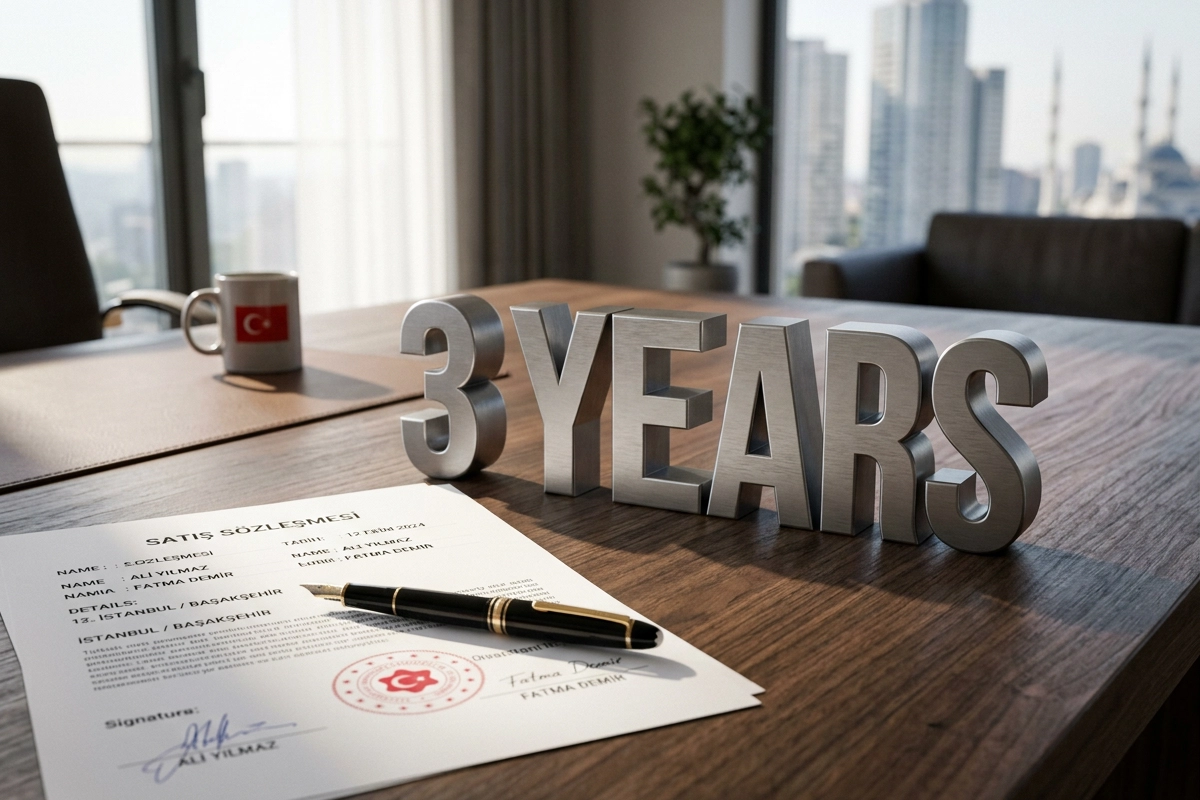
Many foreign investors who obtained Turkish citizenship through real estate investment believe that once the mandatory 3-year holding period ends, their property automatically becomes free for sale.
This is one of the most common misunderstandings in the Turkish property market.
The reality is different: the property remains legally blocked on the title deed until the restriction is formally removed. In other words, the end of the 3-year period does not always mean the investor can immediately sell the property.
This “blocked property” status applies specifically to properties purchased under the Turkish Citizenship by Investment Program, where the investor commits not to sell the asset for at least three years in exchange for citizenship eligibility through a minimum qualifying investment.
Many investors reach the end of the 3-year period and discover that the title deed still carries a restriction annotation, preventing normal sale procedures until the official removal process is completed.
This article explains exactly what blocked properties mean, why the restriction exists, how to remove the 3-year title deed restriction, what documents are required, how the Web Tapu system works, and whether investors can complete the process from outside Turkey.
If your property was purchased for citizenship purposes, understanding this process is not optional—it is essential for protecting your exit strategy.
What Are “Blocked Properties” in Turkish Citizenship Investment?
What does a blocked property mean?
In practical real estate language, “blocked property” refers to a property that carries an official no-sale restriction on the title deed (Tapu), preventing the owner from selling, transferring, or gifting the property freely.
This restriction is not informal—it is a registered legal annotation directly linked to the Turkish Citizenship by Investment process.
When a foreign investor buys a property worth at least the required citizenship threshold and applies for Turkish citizenship, the government places a formal restriction stating that the property cannot be sold for three years.
This creates what many investors call a “blocked property.”
The property remains legally owned by the investor, but its transfer rights are restricted until the legal conditions are fulfilled and the annotation is removed.
Why does Turkey impose a 3-year sale restriction?
The purpose is to protect the credibility of the citizenship-by-investment system.
Without this rule, investors could purchase a property, obtain citizenship quickly, and sell immediately—turning the program into a technical shortcut rather than a genuine long-term investment.
The restriction helps:
- prevent short-term speculation
- ensure serious capital enters the Turkish market
- preserve the integrity of the citizenship program
- Protect the value of Turkish real estate investment
This is why the rule is enforced through the Land Registry itself, not through a separate private agreement.
Does the restriction disappear automatically after 3 years?
This is where most investors make mistakes.
Legally, the investor fulfills the minimum holding obligation after three years from the title deed registration date. However, the title deed restriction itself may still need formal removal through the Land Registry process.
This means:
Finishing 3 years does not automatically mean the blocked property becomes sellable.
The investor must verify whether the title deed still carries the annotation and complete the official removal process if required.
This process is commonly handled through the Web Tapu system under the category known as Terkinler (annotation removal procedures).
Ignoring this step can delay or completely block a resale transaction.
Start a Conversation
Contact us through the communication method that suits you
When Can You Remove the 3-Year Property Restriction?
The 3-year period starts from the Tapu registration date
The countdown begins from the official title deed registration date—not the reservation date, contract date, payment date, or citizenship approval date.
This distinction is extremely important.
Many investors calculate the timeline incorrectly based on the purchase contract rather than the official Tapu registration, which can lead to rejected applications for restriction removal.
The Land Registry only recognizes the Tapu registration date.
Citizenship completion does not remove the title deed block
Many investors assume that once Turkish citizenship is granted, the property becomes unrestricted.
This is incorrect.
Citizenship approval and title deed restriction removal are two separate legal procedures.
Citizenship approval confirms the investor qualified for nationality.
Restriction removal confirms the property is now legally free for resale.
Even if citizenship was granted years ago, the title deed may still require formal clearance.
Why investors must verify before applying
Before starting the process, the investor should verify:
- the exact title deed registration date
- the existence of the restriction annotation
- the status of the Certificate of Conformity
- identity consistency across all documents
Failure to verify these details often causes:
- rejected appointments
- repeated submissions
- delays in future sale transactions
This step saves time and protects the resale timeline.
Certificate of Conformity (Uygunluk Belgesi): The Most Important Document
Why this document matters
The Uygunluk Belgesi (Certificate of Conformity) is one of the most critical documents in the entire file.
It proves that the property originally qualified for Turkish citizenship under the investment rules and was officially approved by the relevant authority.
Without this document, removing the restriction becomes far more complicated.
Many investors lose track of this certificate after receiving citizenship, only to discover its importance years later when trying to sell.
Matching the property with Turkish identity and passport
The title deed office must confirm that:
- the original investor
- the Turkish identity card
- the Turkish passport
- the citizenship-linked property
all belong to the same legal person.
This matching process is essential.
The restriction cannot be removed if the system detects inconsistencies between the original foreign buyer record and the investor’s current Turkish identity documentation.
What happens if the certificate is missing?
Missing documentation creates one of the biggest delays in blocked property cases.
If the investor cannot provide the Certificate of Conformity, additional verification procedures may be required, which can significantly delay the sale process.
In some cases, professional legal support becomes necessary.
This is why document preservation is critical even years after citizenship approval.
What Documents Are Required to Remove the Restriction?
Core title deed and identity documents
Most investors need:
- title deed (Tapu)
- Turkish ID card
- Turkish passport
- original foreign passport (when required)
- old citizenship application references, if available
The file must be internally consistent.
Even minor differences in names, passport numbers, or registration details can create serious delays.
Why sworn translators matter
If the investor does not speak Turkish, a translator is usually required during the title deed appointment.
However, not every translator is acceptable.
The translator must be:
- officially registered with the Tapu Directorate
- recognized by the Land Registry office
Using an external translator who is not officially accepted can result in immediate rejection of the appointment.
This is a very common mistake.
How to Remove the Restriction Through Web Tapu
Step 1: Prepare the complete file
Before opening the Web Tapu request, the investor should review:
- title deed records
- Certificate of Conformity
- identity documents
- translator details if needed
Starting without a complete file creates unnecessary delays.
Step 2: Book the request through Web Tapu
The official process is initiated through the Web Tapu system.
The investor must apply under the category known as:
Terkinler
This refers to annotation removal procedures within the Land Registry system.
This is where the blocked property status is formally reviewed.
Step 3: Upload all supporting documents
All documents are submitted digitally through the system for review.
The Land Registry checks:
- ownership consistency
- citizenship-linked investment history
- legal eligibility for removing the restriction
This review determines whether the request can proceed.
Step 4: Wait for the Tapu Directorate appointment
In most cases, the appointment is issued within 2–3 business days, depending on the city and workload of the local Tapu Directorate.
This timeline may vary, especially in Istanbul, where transaction volume is higher.
Step 5: Attend the appointment and finalize removal
The investor must attend personally or through a legally authorized representative.
Once the review is completed and approved, the restriction is formally removed from the title deed. Only after this step does the property become fully sellable.
Can You Remove the Restriction From Outside Turkey?
Yes—through Power of Attorney
Investors living outside Turkey do not need to travel back just for this procedure.
They can complete the restriction removal through a properly issued Power of Attorney.
This is one of the most practical solutions for international investors.
Who can receive the Power of Attorney?
The investor can authorize:
- a specialized real estate lawyer
- a qualified legal consultant
- a trusted real estate advisor with proper legal coordination
Professional experience matters because mistakes in title deed procedures can delay major transactions.
Why do many investors prefer this route
This option helps:
- avoid international travel
- save time
- reduce procedural mistakes
- protect the resale timeline
For many investors, especially after citizenship is completed, remote execution is the most efficient strategy.
Common Mistakes That Delay Restriction Removal
Assuming the block disappears automatically
This is the biggest mistake.
Three years passing does not always mean the title deed is ready for sale.
Verification is mandatory.
Losing the Certificate of Conformity
This creates serious operational delays and often requires legal reconstruction of the file.
Using an unregistered translator
This can cause appointment rejection and wasted time.
Ignoring title deed inconsistencies
Even small errors in names, passport details, or ownership records can stop the process. Accuracy matters.
Read more: Before Buying Property in Turkey: 4 Questions That Define Your Investment
When Is the Property Truly Ready for Sale?
Only after official title deed clearance
The property becomes fully sellable only after the restriction annotation is officially removed, not simply because three years have passed. This distinction is critical.
How to verify the restriction is removed
The investor must confirm the updated title deed record through the official Land Registry system. Never rely on assumptions.
Can the property be sold immediately after removal?
Yes, once the restriction is formally lifted, the investor can proceed with normal resale, transfer, or reinvestment strategies. This is the true completion of the citizenship property cycle.
Final Thoughts
Blocked properties are not a problem—they are part of the Turkish citizenship investment structure.
The real risk comes from misunderstanding how restriction removal works.
Many investors wait three years and assume everything is automatic, only to face delays when trying to sell.
The smart investor does not simply wait for time to pass.
They prepare the correct documents, verify the title deed status, complete the Terkinler process properly, and protect the resale strategy before the next transaction begins.
Because in Turkish real estate investment, your exit strategy is just as important as your entry.
FAQ
Does the 3-year restriction end automatically?
No. After 3 years, the legal holding period ends, but the title deed restriction may still need formal removal through the Land Registry (Terkinler process).
What is a blocked property in Turkey?
A blocked property is a property purchased for Turkish citizenship that carries a no-sale restriction on the title deed for at least 3 years.
What is the Certificate of Conformity (Uygunluk Belgesi)?
It is the official document proving that the property qualified for Turkish citizenship by investment and is required for restriction removal.
Can I sell my property immediately after 3 years?
Not always. You must first confirm that the restriction annotation has been officially removed from the title deed.
What is Terkinler in Web Tapu?
Terkinler is the section in Web Tapu used to remove title deed restrictions and annotations, including the 3-year citizenship sale block.
Can I remove the restriction from outside Turkey?
Yes. You can complete the process through a Power of Attorney given to a lawyer or authorized real estate consultant.
Do I need a sworn translator?
Yes, if you do not speak Turkish. The translator must be officially registered with the Tapu Directorate.
How long does restriction removal take?
Usually, the Tapu appointment is issued within 2–3 business days after submitting the full file through Web Tapu.
Can I use a real estate consultant instead of a lawyer?
Yes, if legal authorization exists. For complex files, a specialized lawyer is usually safer.
Why do investors face delays?
The main reasons are missing Certificate of Conformity, incorrect Tapu records, and assuming the restriction is removed automatically.