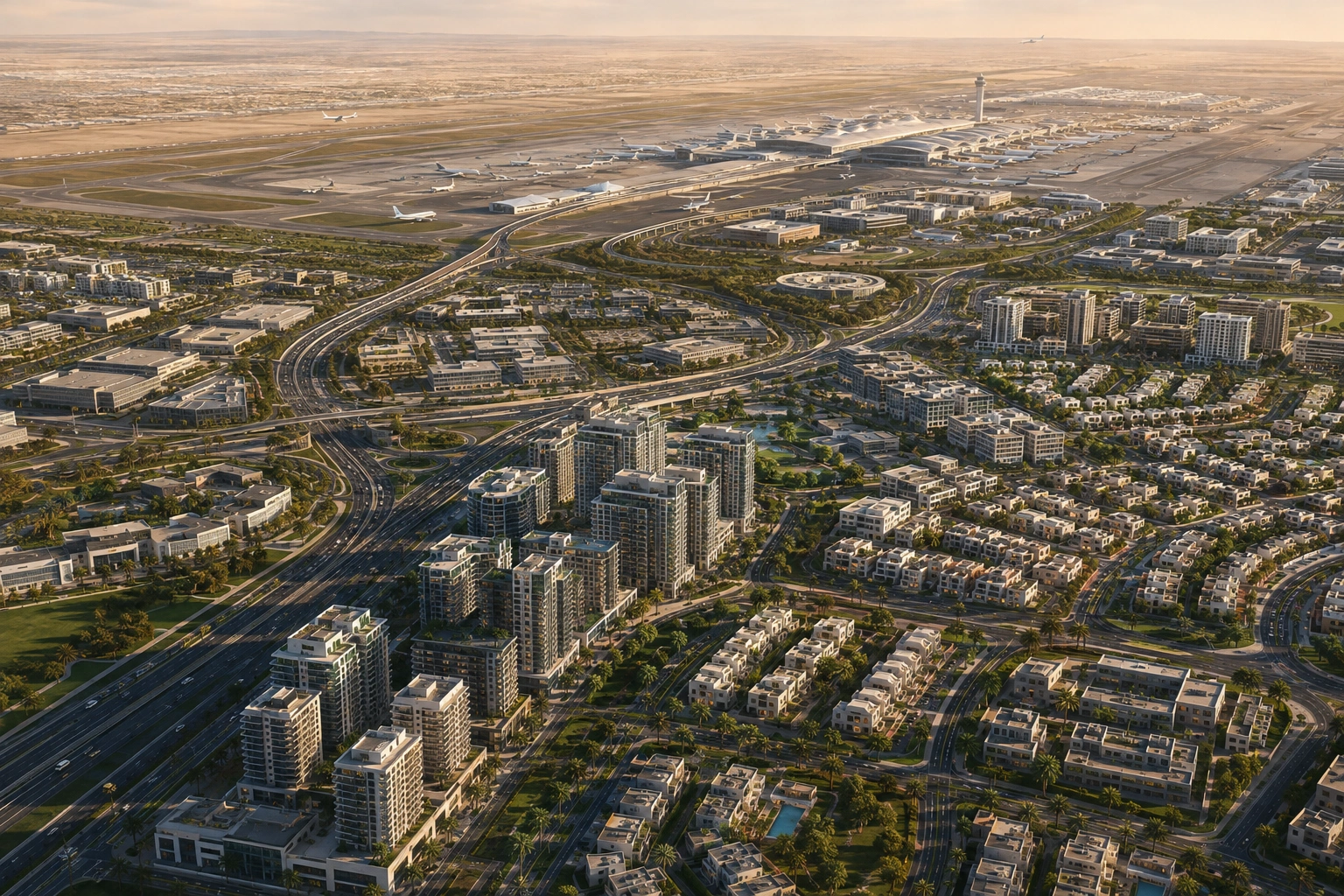
The expansion of Al Maktoum International Airport is changing the long-term investment case for Dubai South. The AED 128 billion development is planned to reach an eventual capacity of more than 260 million passengers annually, supported by five parallel runways and 400 aircraft gates. The first phase is currently scheduled to commence operations in 2032.
For property investors, the opportunity is larger than simply buying an apartment close to an airport. Dubai’s strategy is to develop a much broader economic and residential centre around DWC, supported by aviation, logistics, employment, infrastructure and housing demand. The government has previously stated that development around the airport is expected to create housing demand for a population of around one million people.
That creates a credible long-term demand story for Dubai South, but it does not mean every property around Al Maktoum Airport will appreciate equally. Entry price, distance from employment and transport infrastructure, community maturity, developer quality, future supply, achievable rent and resale demand will determine the performance of individual investments.
For buyers considering Dubai South today, the more useful question is therefore not whether the airport will grow. Construction is already progressing. The investment decision is where within Dubai South to buy, which property type offers the stronger risk-adjusted return, and how much of the airport’s future growth is already reflected in today’s price.
How Will the Al Maktoum International Airport Expansion Affect Dubai South?
Al Maktoum International Airport, commonly known by its airport code DWC, is at the centre of Dubai’s long-term aviation strategy.
The approved development involves a new passenger terminal costing approximately AED 128 billion. At full development, the airport is planned to handle more than 260 million passengers and 12 million tonnes of cargo annually, with five parallel runways and 400 aircraft gates. The wider airport master plan covers approximately 70 square kilometres.
The project has moved beyond the planning stage.
By June 2026, packages worth more than AED 13 billion were already under execution. Work included more than 17,000 concrete piles, over 45 million cubic metres of excavation, core infrastructure and completion of a second runway ahead of rehabilitation work on the existing runway.
Further major packages valued at more than AED 55 billion were being prepared for award, covering components such as the Western Passenger Terminal, aircraft concourses, automated passenger transport, baggage systems and supporting infrastructure.
The first phase remains scheduled to commence operations in 2032.
For Dubai South property investors, that timeline matters.
This is not an infrastructure project expected to transform the residential market overnight. It is a multi-stage development capable of influencing where businesses locate, where employees live and how the southern part of Dubai develops over many years.
That creates a longer investment horizon than a typical property launch.
The Investment Case Extends Beyond Passenger Traffic
Airport passenger numbers receive most of the attention, but the employment and commercial ecosystem around DWC may be more relevant to residential property demand.
A global aviation hub of this scale requires airlines, logistics companies, freight operators, engineering businesses, hospitality, retail, professional services and supporting industries.
Dubai’s official vision explicitly connects the airport expansion with the development of an entire city around it and future housing demand for approximately one million people.
If that employment base develops as planned, Dubai South could gradually move from being perceived primarily as a peripheral growth location into a much larger residential and economic district.
That transition is the fundamental property investment thesis.
Start a Conversation
Contact us through the communication method that suits you
Why Is DWC Becoming Important for Dubai South Property Investment?
DWC matters because infrastructure can create property demand when it is connected to employment and population growth.
An airport alone does not guarantee successful residential investment. The stronger case appears when aviation infrastructure forms part of a wider economic district capable of generating jobs and attracting permanent residents.
Dubai South already combines residential districts with aviation, logistics and commercial activity. The expansion of Al Maktoum International Airport increases the potential scale of that ecosystem considerably.
There is already evidence that the airport announcement affected buyer interest.
Dubai South’s own property division reported that interest in housing increased following the announcement of the new passenger terminals, accompanied by higher sales and rental values in its residential projects. It also reported more than 25,000 residents in the Residential District at that stage, supported by parks, retail, sports facilities, a hypermarket and public transport connecting the district with the Expo Metro station.
The longer-term opportunity is therefore linked to how quickly the gap between future infrastructure and current residential maturity closes.
A property bought today may be held through several stages of that development.
For investors, this makes handover timing and intended holding period particularly important. Someone buying an off-plan property for delivery several years from now is making a different investment decision from a buyer purchasing a ready apartment for immediate rental income.
What Could the Airport Expansion Mean for Dubai South Property Prices?
Infrastructure can support property values when it improves the economic usefulness of a location.
In Dubai South, the airport expansion could influence property prices through several channels: additional employment, population growth, business relocation, improved infrastructure, and greater demand for housing closer to the southern economic corridor.
However, buyers should distinguish between a credible growth catalyst and guaranteed capital appreciation.
Dubai South property prices have already reacted to increased investor attention.
Transaction-based market data through August 2026 places the median residential sale price in the wider Dubai South area at approximately AED 1,643 per square foot, with prices around 3.6% higher year-on-year. More than 16,000 registered sales were recorded over the preceding 12 months, representing approximately AED 26.2 billion in transaction value.
The numbers also show why investors should avoid treating Dubai South as one uniform property market.
Prices vary substantially according to project, property type, developer, completion status and exact location.
Emaar South, for example, has developed its own pricing profile. Market index data for July 2026 placed properties there around AED 1,569 per square foot, while the apartment-specific index was approximately AED 1,678 per square foot.
These figures are useful benchmarks, but they do not establish a fair price for every new launch.
How Much Airport Growth Is Already Included in the Price?
This is one of the most important questions for buyers entering Dubai South after the airport expansion announcement.
An investor buying before a major infrastructure announcement may capture a different portion of the appreciation cycle from someone buying after developers, sellers and other investors have already adjusted their expectations.
A new project cannot be considered attractive simply because it is close to DWC.
If its launch price already assumes years of future infrastructure improvements and rental growth, the investor may be paying today for benefits that will take years to materialise.
Recent transactions in comparable completed properties provide an important reference.
The stronger opportunities are likely to be properties where the current price remains defensible based on today’s market, while future airport-driven development provides additional upside rather than the entire justification for the purchase.
Will Rental Demand Increase Around Al Maktoum Airport and Dubai South?
Rental demand is central to the investment thesis because airport-related development will take place over many years.
Investors need the property to perform during that period rather than depending exclusively on a higher resale price in the future.
The main potential rental-demand drivers include employees connected to aviation and logistics, businesses operating in Dubai South, households working around Expo City and the wider southern Dubai corridor, and residents who prefer more affordable housing than many established central communities.
There is already an established rental market.
Registered market data through August 2026 shows new apartment rents across Dubai South at around AED 59,839 annually, although actual rent varies considerably by unit type and community.
Other DLD-derived analyses of the ready apartment market illustrate the relationship between purchase price and rent more clearly. One analysis covering the 12 months to July 2026 calculated an average ready-apartment sale price of approximately AED 1,143 per square foot and a gross rental yield around 6.1%.
Different datasets produce different yield estimates because they may cover different submarkets, property types and transaction periods. This is particularly important in Dubai South because affordable apartment districts, newer off-plan projects and golf-oriented communities such as Emaar South do not necessarily produce the same rental economics.
Airport Employees Will Not Automatically Rent Every New Unit
The expected growth of DWC creates a strong demand narrative, but investors should be careful when translating future employment numbers directly into rental projections.
Not every employee will live beside the airport. Some will commute from other parts of Dubai, while different income groups will require different housing types and budgets.
At the same time, Dubai South has a substantial development pipeline.
Rental performance will therefore depend on how quickly population and employment growth absorb new residential supply.
This is why investors should compare achievable rent with the actual purchase price of the unit rather than relying on projected future rental demand alone.
A property that already produces an acceptable yield has greater protection if airport-related demand takes longer than expected to develop.
Dubai South vs Emaar South: Where Should Property Investors Focus?
Dubai South and Emaar South should not be treated as interchangeable investment options.
Dubai South is the much broader master-planned area surrounding the airport and includes residential, aviation, logistics and commercial districts.
Emaar South is a specific master-planned residential community within this wider growth corridor.
The distinction matters because the two can suit different investment objectives.
Dubai South for Yield and Lower Entry Prices
Parts of the wider Dubai South residential market can offer lower entry prices than Emaar South, particularly for studios and one-bedroom apartments.
This can improve gross rental yields when rents remain strong relative to acquisition cost.
Such properties may suit investors primarily focused on rental income or buyers seeking a lower capital requirement.
The trade-off is that project selection becomes especially important. Building quality, developer history, service charges, immediate amenities and the amount of competing apartment supply can vary considerably across the wider area.
A lower purchase price is useful only when the property can attract and retain tenants.
Emaar South for Master-Community Positioning
Emaar South offers a different proposition.
The community is built around an 18-hole championship golf course and combines apartments, townhouses and villas with parks, retail and other community infrastructure.
The master plan includes approximately 22,700 residential units, 15,360 apartment units, 25 neighbourhood parks and 53,000 square metres of retail and dining space.
Its location is also directly connected to the airport investment story. The community is positioned close to Al Maktoum International Airport and Expo City, with the developer currently indicating approximately five minutes to DWC.
For investors, Emaar South may therefore appeal more strongly to buyers looking for a recognisable master community, family-oriented housing and a broader resale market extending beyond airport employees.
The price reflects part of that positioning.
Which Is Better?
The answer depends on the investment objective.
An investor prioritising percentage rental yield may find stronger opportunities in selected lower-priced apartment projects across the wider Dubai South market.
A buyer prioritising community maturity, villas or townhouses, family demand and long-term resale positioning may find Emaar South more suitable.
The comparison should ultimately be made at property level.
A well-priced one-bedroom apartment in Dubai South can outperform an overpriced unit in Emaar South. Equally, paying more for a property in a stronger master community can be justified if it produces better occupancy, tenant retention and resale liquidity.
Best Areas and Projects to Invest in Near DWC Airport
There is no single project near Al Maktoum Airport that is automatically the best investment.
The area can instead be divided according to the type of demand the investor wants to capture.
Emaar South: Master-Community and Long-Term Resale Demand
Emaar South is one of the clearest options for investors who want exposure to the airport growth corridor while buying within an established master-community concept.
Its mix of apartments, townhouses and villas allows investors to target different tenant and buyer profiles.
Recent development has expanded the apartment inventory around the golf course. Current projects include communities offering one- to three-bedroom apartments alongside selected townhouse options, while other phases focus on larger villas and family housing.
For apartment investors, the key comparison should be between the launch price and recent transactions in existing Emaar South properties.
For villa and townhouse buyers, the analysis should place greater weight on plot size, built-up area, community position and the depth of future end-user demand.
Dubai South Residential District: Income-Focused Apartments
The Residential District may deserve more attention from investors prioritising rental income.
It already has a resident population and supporting amenities, rather than depending entirely on the future airport expansion to create demand.
Current market evidence also demonstrates why entry price matters.
July 2026 data for the Residential District placed average sales around AED 1,300 per square foot and average rents around AED 75 per square foot annually, producing an estimated gross yield of approximately 5.8% for that particular monthly dataset.
The investor should still analyse the individual building because service charges, maintenance, unit quality and tenant demand can materially change net ROI.
Properties Closer to the DWC Employment Corridor
Projects positioned around aviation, logistics and employment districts present another investment thesis.
Here, the objective is less about lifestyle branding and more about proximity to future employment.
Smaller apartments may work particularly well if they match the budgets and housing preferences of the workforce eventually created around DWC.
But proximity alone should not justify a premium.
Investors should determine whether the surrounding residential environment already offers the services, retail, transport and amenities necessary to support stable occupancy.
Which Property Type Makes the Most Sense?
Studios and one-bedroom apartments can offer attractive percentage yields because of their lower purchase prices, particularly when the local tenant profile supports smaller units.
Two-bedroom apartments can appeal to couples, small families, and residents planning longer stays, potentially broadening the tenant pool.
Townhouses and villas serve a different strategy. Their yields may be lower in percentage terms, but they can benefit from family demand, larger living spaces and a more end-user-oriented resale market.
In Emaar South, this distinction is particularly important because the community offers both apartment and family-housing products.
Investors should therefore decide whether they are buying primarily for income, long-term appreciation, or eventual resale to an end user before choosing the unit.
What Are the Main Risks of Investing Around Al Maktoum Airport?
The scale of the airport development makes the long-term Dubai South story compelling, but large infrastructure projects can also encourage investors to price future growth too aggressively.
The first risk is paying too much for the airport narrative.
The expansion is public information. Developers, sellers and other investors are aware of it, which means part of the expected benefit may already be reflected in land and property prices.
A property should still make financial sense based on realistic market comparisons.
Future Supply
Dubai South has significant room for further residential development.
That is necessary if the area is eventually going to accommodate a much larger population, but it also means individual properties will face competition from newer projects.
An investor buying an apartment for handover in several years should examine what else is scheduled to complete around the same time.
Future population growth matters, but so does the number of properties competing for that population.
Long Development Timeline
The first phase of the airport is scheduled to commence operations in 2032, while the ultimate 260-million-passenger capacity represents the longer-term final development.
Investors should therefore avoid treating the full airport vision as if it will be delivered at once.
A five- or ten-year holding strategy may fit the infrastructure story better than a short speculative purchase based primarily on airport-related appreciation.
Off-Plan Pricing Risk
A flexible payment plan can make an off-plan project attractive without necessarily making the underlying property inexpensive.
Investors should compare the price per square foot with completed properties and competing launches.
If the property carries a substantial premium because of expected future airport growth, the investor needs to determine whether realistic rental income and resale demand can eventually support that valuation.
Rental Demand May Develop Unevenly
Employment growth does not affect every residential project equally.
Workers in aviation, logistics, management and professional services have different housing budgets and requirements. Families may prioritise schools and larger homes, while individual employees may prefer smaller apartments and transport convenience.
The strongest rental investment is therefore likely to be a property whose unit type, price and location correspond with a clearly identifiable tenant market.
Resale Liquidity
Investors also need to consider who will purchase the property from them.
A unit with a competitive price, practical layout and established rental history can appeal to another investor.
A townhouse or villa in a mature family community may attract end users.
Properties whose resale argument depends almost entirely on the future airport may have a narrower buyer pool if market sentiment changes.
Check the Best location in Dubai for Real estate investment
Meydan
Dubai Land
Dubai South
check now
Is Dubai South a Good Property Investment?
Dubai South has one of Dubai’s clearest long-term infrastructure-led property stories.
The Al Maktoum International Airport expansion is no longer simply a proposed concept. Construction is progressing, billions of dirhams of contracts are under execution, and the first phase remains targeted to commence operations in 2032. The eventual plan for more than 260 million passengers, 12 million tonnes of annual cargo and an entire economic city around the airport gives the area a demand catalyst that extends far beyond residential development.
Current property data also shows that Dubai South is already an active market rather than an investment based entirely on future infrastructure. More than 16,000 registered transactions were recorded over the 12 months to August 2026, while an established rental market provides investors with current evidence against which future projections can be tested.
The investment case becomes weaker when a buyer assumes that every property close to DWC will benefit equally.
For investors focused on rental income, selected apartments in the wider Dubai South residential market may provide more attractive entry prices and stronger percentage yields.
For buyers prioritising master-community quality, family demand and longer-term resale potential, Emaar South presents a different proposition through its combination of apartments, townhouses, villas, golf facilities and proximity to both DWC and Expo City.
The deciding factor should remain the individual property.
Dubai South can benefit substantially from the growth of Al Maktoum International Airport without every Dubai South property becoming a good investment. Buyers still need to compare entry price, achievable rent, service charges, future supply, developer quality, and resale demand.
The airport provides the long-term catalyst. The price and property chosen today will determine how much of that opportunity ultimately reaches the investor.
Frequently Asked Questions
Will Al Maktoum International Airport increase Dubai South property prices?
The airport expansion can support property values by creating employment, improving infrastructure and attracting more residents and businesses to Dubai South. However, appreciation is not guaranteed. Entry price, future residential supply, project quality and the speed at which employment and population growth develop will influence individual property performance.
When will the new Al Maktoum International Airport be completed?
The development is being delivered in phases. As of the June 2026 official update, the first phase is scheduled to commence operations in 2032. The eventual capacity of more than 260 million passengers belongs to the airport’s longer-term master plan rather than the first phase alone.
Is it better to invest in Dubai South or Emaar South?
Neither is automatically better. Selected areas of wider Dubai South can suit investors seeking lower entry prices and rental yield, while Emaar South may appeal more to investors prioritising a master-planned community, family housing and long-term resale demand. The individual property’s price and expected net return should determine the final choice.
Is property near DWC Airport good for rental income?
It can be, particularly as aviation, logistics and commercial employment around Dubai South expands. Investors should still use current rental evidence rather than basing returns entirely on future airport employment. The purchase price, service charges, vacancy and amount of competing rental supply determine the actual net yield.
Should I buy off-plan property near Al Maktoum Airport now or wait?
Buying earlier can provide exposure to future infrastructure development, but it also increases the time and uncertainty before the airport reaches its planned scale. A strong off-plan purchase should make sense at its current price compared with ready properties and competing launches, without requiring aggressive appreciation assumptions to produce an acceptable return.
What should I check before buying property in Dubai South?
Compare recent transaction prices, achievable rent, service charges, future project supply, developer delivery history and the property’s expected handover date. For airport-related investments, also consider whether the property has a viable tenant and resale market under current conditions rather than relying exclusively on the future expansion of DWC.