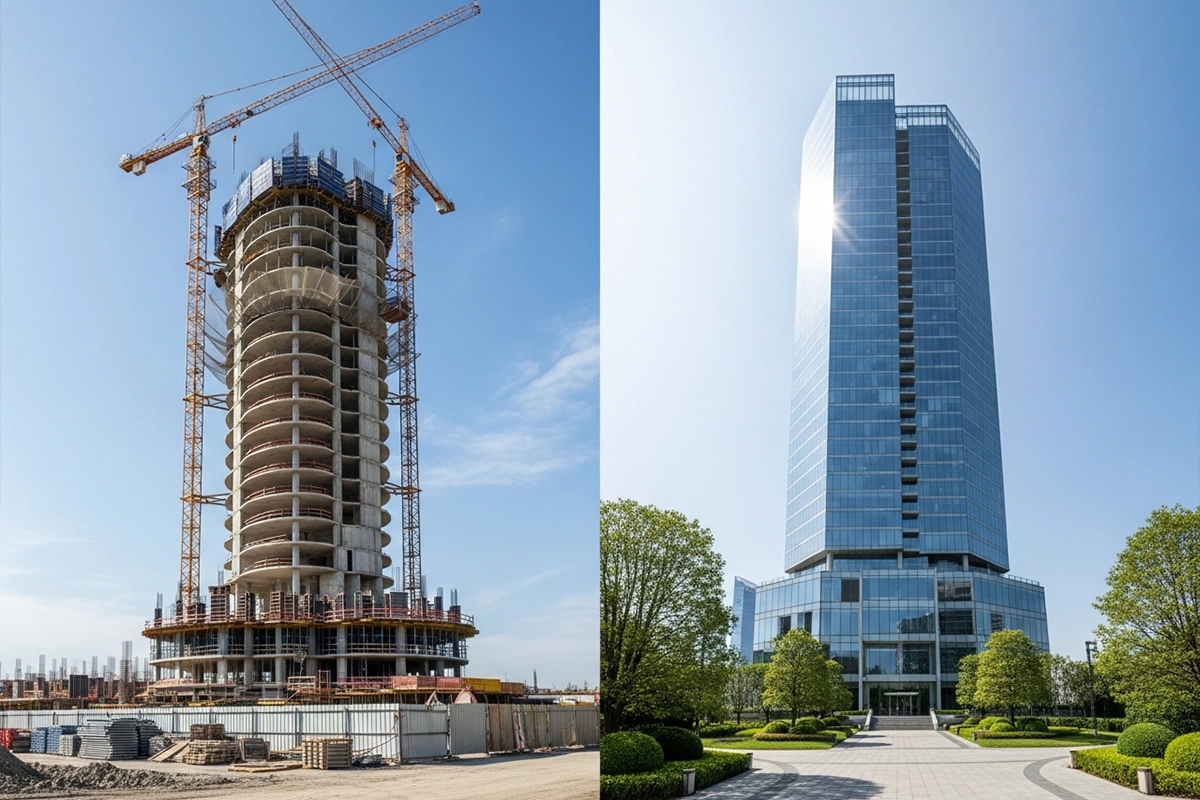
Off-plan property Dubai opportunities are often presented as one of the most efficient ways to enter the market with lower capital and higher upside. Yet, for many investors, the central concern remains the same: is this model actually risky, or is the risk overstated?
The answer requires nuance. Dubai real estate risk is not defined by the off-plan model itself, but by how the investment is selected, structured, and timed. While the market offers strong regulatory protection and consistent demand, there are real risks that must be understood before committing capital. At the same time, there are clear strategies that experienced investors use to reduce exposure and improve outcomes.
This article breaks down the reality behind off-plan project risk in Dubai, separates perception from fact, and outlines how to approach investment in off-plan properties in 2026 with a controlled, data-driven mindset.
What Off-Plan Property Means in Practice
Off-plan property refers to purchasing real estate before construction is completed. In Dubai, this typically involves staged payments linked to construction milestones, with the expectation that the asset will either appreciate in value before handover or generate rental income after completion.
Investors choose this model primarily for three reasons. First, entry prices are generally lower compared to ready properties in the same area. Second, payment plans reduce immediate capital pressure, allowing buyers to spread costs over time. Third, there is potential for capital appreciation between launch and completion, particularly in high-demand locations.
However, these advantages introduce timing, execution, and market exposure variables that do not exist in ready property investments.
Is Off-Plan Property in Dubai Actually Risky?
Off-plan property Dubai investments are not inherently risky, but they are conditional. The level of risk depends on three core factors: developer reliability, entry price, and location demand.
Dubai properties are not risky by default. The market is regulated, escrow systems are enforced, and developer activity is monitored. However, poor decision-making at the investor level—such as overpaying, selecting weak developers, or entering oversupplied segments—can significantly increase risk exposure.
In other words, the model is stable, but outcomes vary depending on execution.
Start a Conversation
Contact us through the communication method that suits you
The Real Risks of Off-Plan Property in Dubai
Project Delays and Timeline Risk
Project delays remain one of the most discussed aspects of off-plan project risk in Dubai. Delays can impact the expected return timeline by postponing rental income or resale opportunities. For investors relying on projected cash flow, this can create financial pressure or opportunity cost.
However, delays are not uniform across the market. Projects by established developers tend to follow more predictable timelines, while smaller or less experienced developers may face execution challenges. The key issue is not the existence of delays, but the probability of delay based on developer history.
Developer Reliability as the Primary Risk Factor
Among all variables, developer reliability is the most critical determinant of investment success. Weak developers introduce multiple layers of risk, including construction delays, design changes, and quality inconsistencies.
In contrast, established developers with a strong delivery track record reduce uncertainty significantly. This is why professional investors prioritize developer evaluation before analyzing price or payment plans.
Dubai real estate risk, in this context, is less about the market and more about counterparty risk.
Read more: Top Real Estate Developers in Dubai (2026): How to Evaluate Reputation, Delivery, and Risk
Market Fluctuations Before Completion
Off-plan investments are exposed to market movement during the construction period. If prices stabilize or decline before completion, the expected appreciation may not materialize as projected.
This risk is particularly relevant for investors planning to exit before handover. While Dubai’s long-term demand remains strong, short-term fluctuations can affect timing and profitability.
Overpricing at Launch
Not all off-plan opportunities are priced below market value. Some launches are positioned aggressively, particularly in high-demand areas where branding and marketing influence perception.
Entering at an inflated price reduces margin for appreciation and increases downside exposure. Investors who rely solely on marketing narratives without comparing market benchmarks may overpay.
Liquidity Risk Before Handover
Selling an off-plan unit before completion is possible, but not guaranteed. Liquidity depends on market conditions, project demand, and transfer policies.
In slower market phases, resale opportunities may take longer, or require price adjustments. Investors who require fast exit flexibility should account for this limitation.
Read more: What Happens If a Developer Delays a Project in Dubai? Investor Rights, Compensation & Exit Options (2026)
What Makes Off-Plan Investment Safer in Dubai
Despite these risks, Dubai offers one of the most structured environments for off-plan investment globally. Safety is not accidental; it is built into the system.
The escrow mechanism ensures that buyer funds are tied directly to construction progress. Payments are released in stages, reducing the risk of fund misuse. This regulatory framework significantly lowers the likelihood of project failure compared to less regulated markets.
In addition, choosing the right entry point is essential. Investors who secure units at early-stage pricing typically create a buffer that protects against short-term market fluctuations. Price discipline is a fundamental risk control tool.
Location also plays a central role. High-demand areas such as Business Bay, JVC, JVT, and Al Jaddaf maintain strong tenant demand and resale activity. This demand acts as a stabilizing force, reducing both vacancy risk and exit difficulty.
Strategic Approaches to Investment in Off-Plan Properties
In 2026, successful investment in off-plan properties is not based on a single approach. It depends on aligning strategy with capital, risk tolerance, and time horizon.
One common approach is early entry with a planned exit before handover. This strategy focuses on capturing price appreciation during the construction phase. It requires market awareness and timing, but can deliver strong returns with relatively lower capital exposure.
Another approach is long-term holding for rental income. Investors who adopt this model prioritize location and unit type, aiming for consistent occupancy after completion. This strategy reduces reliance on market timing and focuses on stable Dubai real estate ROI.
A third approach involves focusing on affordable segments, particularly studios and one-bedroom units. These units consistently demonstrate higher demand, faster leasing cycles, and stronger liquidity. In practical terms, affordability increases both rental stability and resale flexibility.
Where Low-Risk Opportunities Exist in 2026
Low-risk does not mean no risk; it means controlled exposure.
Projects developed by established names such as Sobha, DAMAC, and Binghatti generally offer stronger execution reliability. These developers benefit from brand trust, financial strength, and consistent delivery records.
At the same time, project selection should reflect investment goals. Premium projects in central areas like Business Bay may offer stronger long-term appreciation and align with investors seeking asset quality. Mid-market projects in JVC or JVT may offer higher rental yields and faster occupancy.
Growth areas such as Al Jaddaf present a hybrid opportunity, combining relatively lower entry prices with improving infrastructure and demand expansion.
Check the project: The Willows at Sobha Sanctuary
Off-Plan vs Ready Property: Risk Perspective
From a risk standpoint, ready properties offer immediate income and lower uncertainty. Investors can assess actual rental performance, occupancy, and market demand before purchasing.
Off-plan properties, in contrast, offer higher upside but introduce execution and timing variables. The trade-off is clear: higher potential returns in exchange for delayed income and controlled risk exposure.
The decision should not be based on which option is safer in absolute terms, but on which aligns with the investor’s financial objectives.
Investor Suitability: Who Should Consider Off-Plan
Off-plan investment is suitable for investors who can operate within a medium to long-term horizon. It requires patience, structured planning, and tolerance for controlled uncertainty.
Investors seeking immediate rental income, or those with low risk tolerance, may find ready properties more appropriate. Similarly, investors who require high liquidity in the short term should be cautious when entering off-plan positions.
The model rewards discipline, not speculation.
Golden Visa Consideration
One of the additional advantages of investment in off-plan properties in Dubai is the potential eligibility for residency. Investors can qualify for the Golden Visa by owning an off-plan property in Dubai, provided the total property value meets the required threshold, typically AED 2 million or more.
This adds a strategic dimension beyond financial return, particularly for investors considering long-term presence in the UAE.
Read more: Where to Invest 2 Million AED in Dubai? A Smart Investor’s 2026 Strategy
Final Verdict: Is Off-Plan Property in Dubai Worth the Risk in 2026?
Off-plan property Dubai investments are not risk-free, but they are not inherently risky either. The market is structured, regulated, and supported by strong demand fundamentals.
The real variable is not the asset class—it is the investor’s decision-making process.
Dubai real estate risk emerges when investors:
enter at the wrong price,
choose unreliable developers,
or apply the wrong strategy for their financial goals.
When approached correctly, off-plan investment becomes a controlled and scalable opportunity. It allows investors to enter the market efficiently, benefit from long-term growth, and structure their portfolio with flexibility.
In 2026, the most relevant question is no longer whether off-plan is risky.
It is whether the investor understands how to manage that risk—and turn it into a strategic advantage.
Read more: Off-Plan vs Ready Property in Dubai (2026): The Investor Safety Ladder Explained