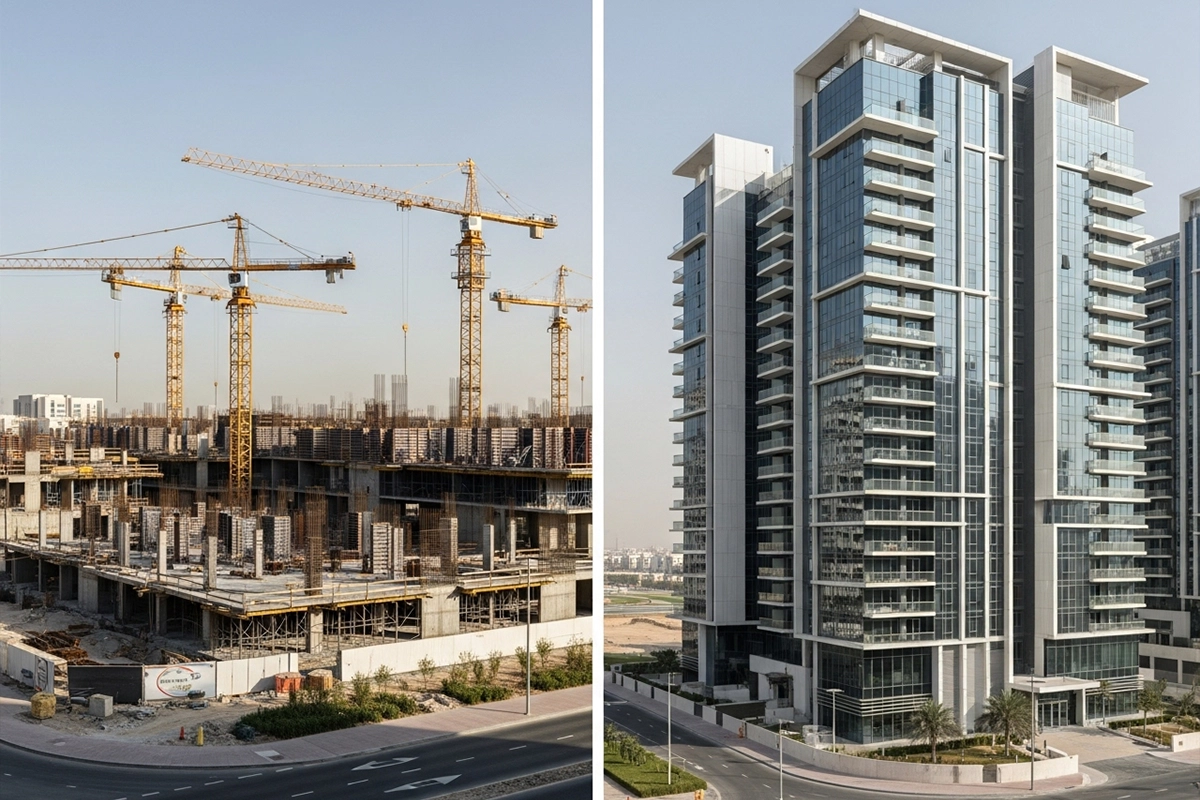
Choosing between off-plan and ready properties in Dubai is one of the most critical decisions foreign investors face in 2026. Both options offer attractive returns, but they operate on fundamentally different risk, cash flow, and timing models.
This article introduces the Investor Safety Ladder, a practical framework that helps investors align property type with their investment goals—whether capital growth, immediate income, or long-term stability—before committing capital.
Off-plan properties in Dubai provide lower entry prices and flexible payment plans, while ready properties offer immediate rental income and lower execution risk. The best option depends on your investment horizon, risk tolerance, and ROI expectations in 2026.
Understanding Off-Plan Properties in Dubai (2026)
What Is an Off-Plan Property?
An off-plan property is purchased directly from a developer before construction is completed or, in some cases, before it begins. Ownership is registered, but possession and rental income start only after handover.
In Dubai, off-plan projects are regulated, escrow-backed, and subject to milestone-based construction controls, which reduces—but does not eliminate—execution risk.
To understand why investors continue to favor this segment, we must examine its financial advantages.
Start a Conversation
Contact us through the communication method that suits you
Why Investors Choose Off-Plan Projects
Flexible Payment Plans and Lower Entry Prices
Off-plan investments in Dubai are structured to lower the financial barrier to entry while maximizing long-term upside. Instead of paying the full property value upfront, investors typically commit to an initial down payment ranging between 10% and 20%, followed by staged installments tied to construction milestones or extended post-handover payment plans that may stretch over several years.
This payment structure offers several strategic advantages. First, it reduces initial capital pressure, allowing investors to enter premium developments without locking large amounts of liquidity at once. This is particularly relevant in 2026, where global investors are increasingly focused on cash flow flexibility and risk-adjusted deployment of capital.
Second, staggered payments enable portfolio diversification. Rather than allocating capital to a single completed asset, investors can spread exposure across multiple off-plan projects, locations, or developers, improving overall risk distribution within their real estate portfolio.
Third, off-plan pricing models often enhance leverage efficiency. By paying gradually while the asset is being built, investors can align capital deployment with market cycles, inflation trends, and potential currency movements, especially when investment capital originates outside the UAE.
In addition, developers usually launch off-plan units at below-market prices to accelerate early sales. This creates built-in equity for early-stage buyers, as property values tend to adjust upward as construction progresses and project risk declines. By the time of completion or handover, investors may already hold unrealized capital gains before generating any rental income.
Taken together, these factors explain why off-plan properties are often favored by investors seeking capital appreciation, flexible entry, and long-term growth, setting the stage for a deeper comparison with ready properties, where income timing and risk profiles differ significantly.
Capital Appreciation Before Handover
The primary appeal of off-plan property investments lies in capital appreciation generated before the asset becomes income-producing. Unlike ready properties, where value is largely established at purchase, off-plan units benefit from a progressive repricing effect as construction advances and project risk diminishes over time.
During the early launch phase, developers typically price units at a discount to compensate investors for construction risk and longer holding periods. As the project moves through structural completion, finishing stages, and regulatory approvals, this risk premium gradually erodes, allowing unit prices to adjust upward toward market benchmarks for completed properties.
Capital appreciation tends to be strongest when off-plan projects are introduced early within growth-oriented zones, where infrastructure expansion, transport links, and commercial development are still unfolding. In such areas, the combined impact of public investment and private development amplifies price momentum beyond the project itself.
Developer reputation plays a critical role as well. Projects delivered by well-established builders with consistent handover records often experience faster price appreciation, as buyer confidence reduces resale friction even before completion. This liquidity effect allows some investors to exit prior to handover, particularly in high-demand segments.
Equally important is end-user demand, which acts as a price stabilizer. Off-plan developments aligned with realistic residential needs—such as proximity to employment hubs, lifestyle amenities, and transport—tend to appreciate more sustainably than purely speculative launches.
However, this appreciation remains unrealized until either resale or handover, introducing a timing dependency that investors must account for. Market cycles, regulatory changes, and macroeconomic conditions can influence exit timing, making off-plan appreciation more suitable for investors with medium- to long-term horizons rather than those seeking immediate returns.
This dynamic contrasts sharply with ready properties, where pricing reflects completed status but offers immediate income generation, a distinction that becomes central when comparing risk profiles and return timing across both investment paths.
ROI Profile of Off-Plan Investments
Expected ROI Timeline (Before vs After Completion)
Off-plan ROI is typically back-loaded:
- Before handover: Unrealized capital gains
- After handover: Rental yield + resale upside
Investors must therefore tolerate delayed cash flow in exchange for higher long-term upside.
Understanding Ready Properties in Dubai (2026)
What Is a Ready Property?
A ready property is fully constructed, registered, and immediately usable—either vacant or tenant-occupied. Ownership transfers instantly, allowing investors to generate income from day one.
This clarity makes ready assets particularly attractive to conservative or income-focused investors.
With that foundation, let’s explore why this segment remains a core pillar of Dubai’s real estate market.
Why Investors Prefer Ready Properties
Immediate Rental Income
Ready properties offer instant rental returns, making them ideal for:
- Income-focused portfolios
- Investors seeking predictable cash flow
- Risk-averse capital preservation strategies
Rental yields are transparent, market-tested, and less dependent on future assumptions.
Lower Execution and Delivery Risk
Unlike off-plan purchases, ready properties eliminate:
- Construction delays
- Design changes
- Delivery uncertainty
Investors can inspect the asset, verify building quality, and assess tenant demand before purchase.
ROI Profile of Ready Property Investments
Net Rental Yield vs Capital Growth
Ready properties generally offer:
- Stable rental yields
- Slower but steady capital appreciation
While upside potential may be lower than early off-plan investments, risk-adjusted returns are often more predictable.
Off-Plan vs Ready Property — Side-by-Side Comparison (2026)
Investment Comparison Overview
| Factor | Off-Plan Property | Ready Property |
| Entry Price | Lower | Higher |
| Payment Plan | Flexible, long-term | Mostly upfront |
| Rental Income | After completion | Immediate |
| Risk Level | Medium | Low |
| Capital Appreciation | Higher potential | Moderate |
| Investor Profile | Growth-focused | Income-focused |
This comparison clarifies structural differences, but selecting the right option still depends on how risk and time align with investor goals.
The Investor Safety Ladder — Which Option Fits You?
Growth-Oriented Investors
Off-plan properties suit investors who:
- Accept delayed income
- Target capital appreciation
- Operate on medium-to-long timelines
The key risk lies not in the model itself, but in developer selection and market timing.
Income-Oriented Investors
Ready properties fit investors who:
- Require immediate returns
- Prefer predictable performance
- Prioritize asset visibility and stability
This approach favors consistency over aggressive growth.
ROI Scenarios in Dubai (2026)
Sample ROI Scenarios (Indicative)
| Scenario | Off-Plan | Ready |
| Entry Strategy | Early launch | Secondary market |
| ROI Start | After handover | Immediate |
| Risk Exposure | Market cycle | Tenant vacancy |
| Best Use Case | Capital growth | Stable income |
These scenarios highlight how ROI behaves differently under each model, reinforcing the importance of strategy alignment.
Residency and Ownership Considerations
Can Off-Plan or Ready Property Qualify for Residency or Long-Term Visas?
Both off-plan and ready properties may qualify for long-term residency options, provided legal thresholds are met. Eligibility depends on:
- Property valuation
- Ownership registration
- Compliance with holding requirements
The determining factor is legal compliance, not property type.
Start a Conversation
Contact us through the communication method that suits you
Common Investor Questions
Which Is Better in Dubai — Off-Plan or Ready Property?
Neither is universally better. Off-plan favors growth, while ready property favors income and stability.
Is Off-Plan Risky in Dubai?
Risk exists but is mitigated by regulation, escrow accounts, and milestone-based payments. Developer selection is critical.
Can I Sell an Off-Plan Property Before Completion?
Yes, subject to developer approval, DLD regulations, and payment progress.
Do Ready Properties Always Generate Higher ROI?
Not necessarily. Ready properties generate faster ROI, while off-plan investments may deliver higher total returns over time.
Final Decision Framework
- Choose off-plan if your priority is capital growth and payment flexibility
- Choose ready property if your focus is immediate income and lower risk
In Dubai’s 2026 real estate market, the smartest investors do not ask which option is better, but rather which option fits their strategy.
Read More: How to Buy Property in Dubai as a Foreigner (2026): Legal Process, Costs, and Ownership Rules