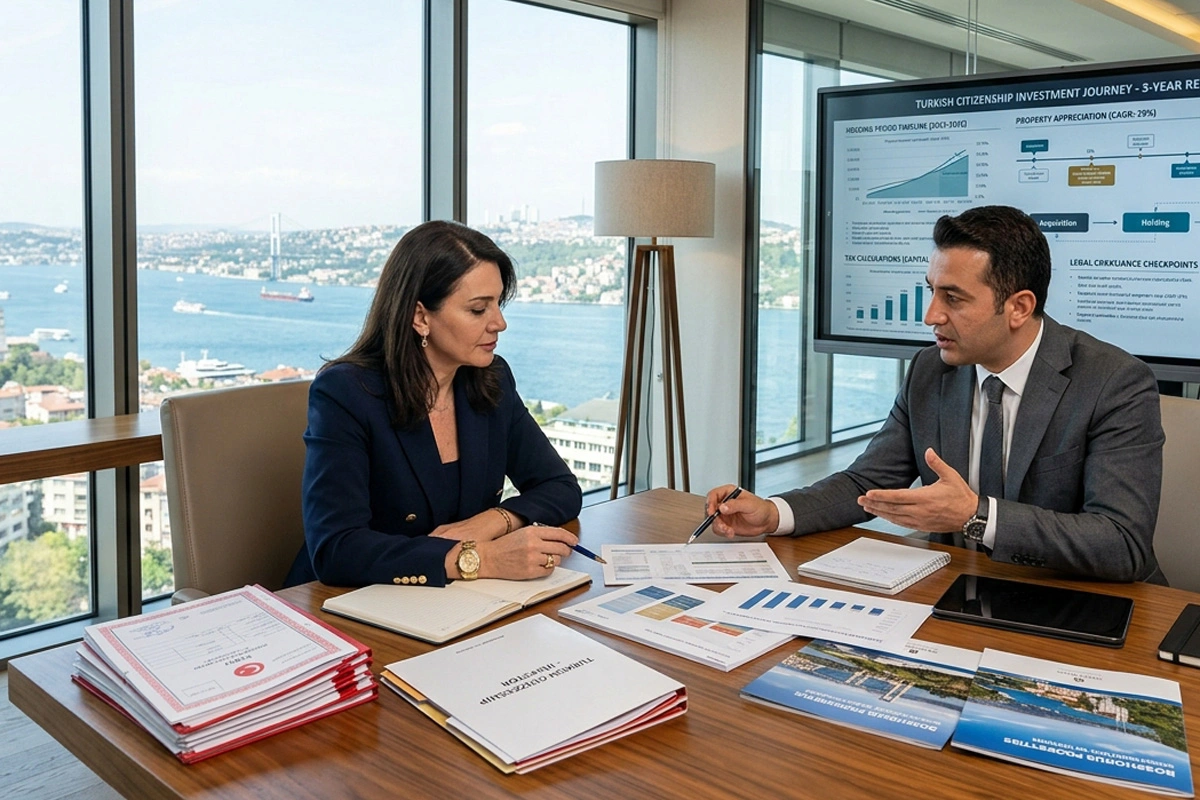
If you’ve completed the mandatory three-year holding period for your Turkish citizenship property, you can generally sell the property once the no-sale annotation has expired or has been formally removed from the title deed. Selling after complying with the three-year requirement does not ordinarily result in losing your Turkish citizenship. However, the better question is not whether you can sell—but whether you should. Before listing the property, compare its current market value, rental yield, expected future appreciation, selling costs, tax implications, and your next investment opportunity. In many cases, holding the property may produce stronger long-term returns than selling immediately.
For many investors, obtaining Turkish citizenship is only the first milestone.
Three years later, a far more important question appears:
What should you do with the property now?
Some investors immediately plan to sell as soon as the restriction ends, believing the property’s role has finished. Others continue holding it without evaluating whether it still deserves a place in their portfolio.
Neither approach is automatically correct.
The end of the three-year holding period simply gives you a new level of flexibility. From that point onward, your property should no longer be viewed as a citizenship requirement—it should be evaluated like any other investment.
This guide explains when selling makes financial sense, when holding creates more value, and which factors every investor should analyse before making a decision.
Start a Conversation
Contact us through the communication method that suits you
To qualify for Turkish citizenship through real estate investment, buyers must purchase a qualifying property and commit not to sell it for at least three years.
This restriction is recorded as an annotation on the property’s title deed during the citizenship process.
The purpose is to ensure that the investment remains in Türkiye for the required period rather than being sold immediately after citizenship approval.
One important detail many investors misunderstand is when those three years actually begin.
The countdown is not based on:
Receiving your Turkish passport.
Citizenship approval.
Signing the reservation contract.
Moving into the apartment.
Instead, investors should verify the official date recorded in the title deed and citizenship transaction documents.
Before contacting agents or accepting offers, confirm that the restriction has expired and that any required administrative procedures for removing the annotation have been completed.
Once the mandatory holding period has been completed and the title deed is legally clear for transfer, the property can generally be sold like any other privately owned real estate.
However, experienced investors avoid rushing to market immediately.
Before listing the property, confirm:
The restriction has officially expired.
The title deed contains no remaining sale restrictions.
No mortgages or legal annotations are affecting the transfer.
All ownership information is up to date.
Property taxes and site management fees are current.
Many owners assume that reaching the three-year anniversary automatically makes the property ready for sale. In practice, verifying the legal status before signing a sales agreement can help avoid unnecessary delays during closing.
The good news is that selling the qualifying property after fully complying with the mandatory holding period does not ordinarily result in the loss of Turkish citizenship simply because the property has been sold.
Once the investment requirement has been fulfilled, the property is no longer tied to maintaining citizenship in the same way it was during the restricted period.
However, this assumes that:
The original investment complied with all program requirements.
The three-year holding obligation was fully respected.
The citizenship application contained accurate documentation.
No fraudulent transactions or artificial property valuations were involved.
For investors who completed the process correctly, the decision after three years becomes an investment decision rather than an immigration decision.
One of the biggest mistakes investors make is comparing today’s selling price with the original purchase price.
That comparison rarely reflects the true financial outcome.
Instead, calculate your net proceeds after all selling costs have been deducted.
Selling Cost
What to Consider
Agent commission
Commission percentage and VAT
Lawyer or accountant
Legal review and tax advice
Title deed expenses
Transfer costs agreed between buyer and seller
Capital gains tax
Depends on your individual tax position and applicable rules
Property tax
Outstanding municipal balances
Site management fees
Any unpaid aidat or special assessments
Currency exchange
Bank transfer and conversion costs
One important point to remember is that the three-year citizenship holding requirement and the tax treatment of a property sale are not the same thing.
Many investors mistakenly believe that because they are allowed to sell after three years, the sale is automatically tax-free.
That assumption can be expensive.
Before accepting an offer, ask a Turkish tax adviser to estimate your expected net proceeds after taxes and transaction costs.
The number that matters is how much money reaches your bank account—not the advertised selling price.
Many citizenship investors focus entirely on the legal restriction and overlook the financial side of the decision.
Some of the most common mistakes include:
Selling immediately after three years without analysing market conditions.
Holding the property simply because it was used for citizenship.
Assuming the sale is automatically tax-free.
Ignoring currency conversion costs.
Accepting unrealistic valuations from estate agents.
Forgetting maintenance costs and future renovations.
Comparing gross selling price instead of net proceeds.
Listing the property before confirming that the title deed is legally ready for transfer.
Making emotional rather than financial decisions.
A property that successfully delivered Turkish citizenship should still be evaluated using the same investment principles as any other asset in your portfolio.
How to decide whether to sell or hold
If you’re unsure, work through these four questions.
1. Can you legally sell today?
Confirm:
The three-year restriction has expired.
The title deed is ready for transfer.
No legal restrictions are preventing the sale.
2. What would you actually receive?
Calculate your expected net proceeds after deducting:
Taxes.
Agent commission.
Legal fees.
Currency conversion costs.
Outstanding debts.
3. What would happen if you held the property?
Estimate:
Annual rental income.
Vacancy risk.
Maintenance expenses.
Expected appreciation over the next five years.
4. Is there a better use for your capital?
Selling only makes sense if the proceeds can produce a stronger overall return elsewhere.
If your Turkish property continues generating competitive rental income while appreciating in value, holding may remain the better strategy.
Have you confirmed the title deed is ready for transfer?
☐
☐
Do you know your estimated net proceeds after all costs?
☐
☐
Is the property still delivering competitive rental returns?
☐
☐
Have you compared it with alternative investments?
☐
☐
Are you selling for a financial reason rather than simply because three years have passed?
☐
☐
If you cannot confidently answer Yes to these questions, it may be worth delaying your decision until you have a clearer financial picture.
Conclusion
Completing the three-year holding period gives you the freedom to choose, not an obligation to sell.
The strongest investors treat this moment as a portfolio review rather than a legal milestone. Instead of asking “Can I sell?”, ask “Does selling improve my overall investment performance?”
If your property has already delivered strong appreciation and you have a better opportunity for your capital, selling may be the right move. If it continues generating healthy rental income in an area with long-term growth potential, holding may create greater wealth over time.
Ultimately, the best decision is the one based on net returns, market conditions, and your investment objectives—not simply because the three-year restriction has come to an end.
Can I sell my Turkish citizenship property immediately after three years?
In most cases, yes. Once the mandatory holding period has ended and the title deed is legally clear for transfer, the property can generally be sold. Before listing it, confirm that the no-sale annotation has expired or has been removed.
Will I lose Turkish citizenship if I sell the property?
Generally, no. Selling the property after complying with the mandatory holding period does not ordinarily cause Turkish citizenship to be revoked solely because the qualifying property has been sold.
Is selling after three years automatically tax-free?
No. The citizenship holding period and the tax treatment of a property sale are separate matters. Before selling, obtain professional tax advice to understand your individual tax obligations.
Should I sell as soon as the restriction ends?
Not necessarily. The decision should depend on your property’s current value, rental performance, expected appreciation, transaction costs, and your broader investment goals—not simply the end of the three-year period.
Can I continue renting the property instead of selling it?
Yes. Completing the three-year holding period does not require you to sell. Many investors continue renting their properties when rental income and long-term appreciation remain attractive.
How do I know if holding is financially better?
Compare the property’s expected future rental income and appreciation with the net return you could achieve by selling and investing the proceeds elsewhere. The stronger long-term return should guide your decision.
What should I check before putting the property on the market?
Verify that the title deed is ready for transfer, the restriction has been cleared, taxes and maintenance fees are up to date, and you have calculated your expected net proceeds after all selling costs.