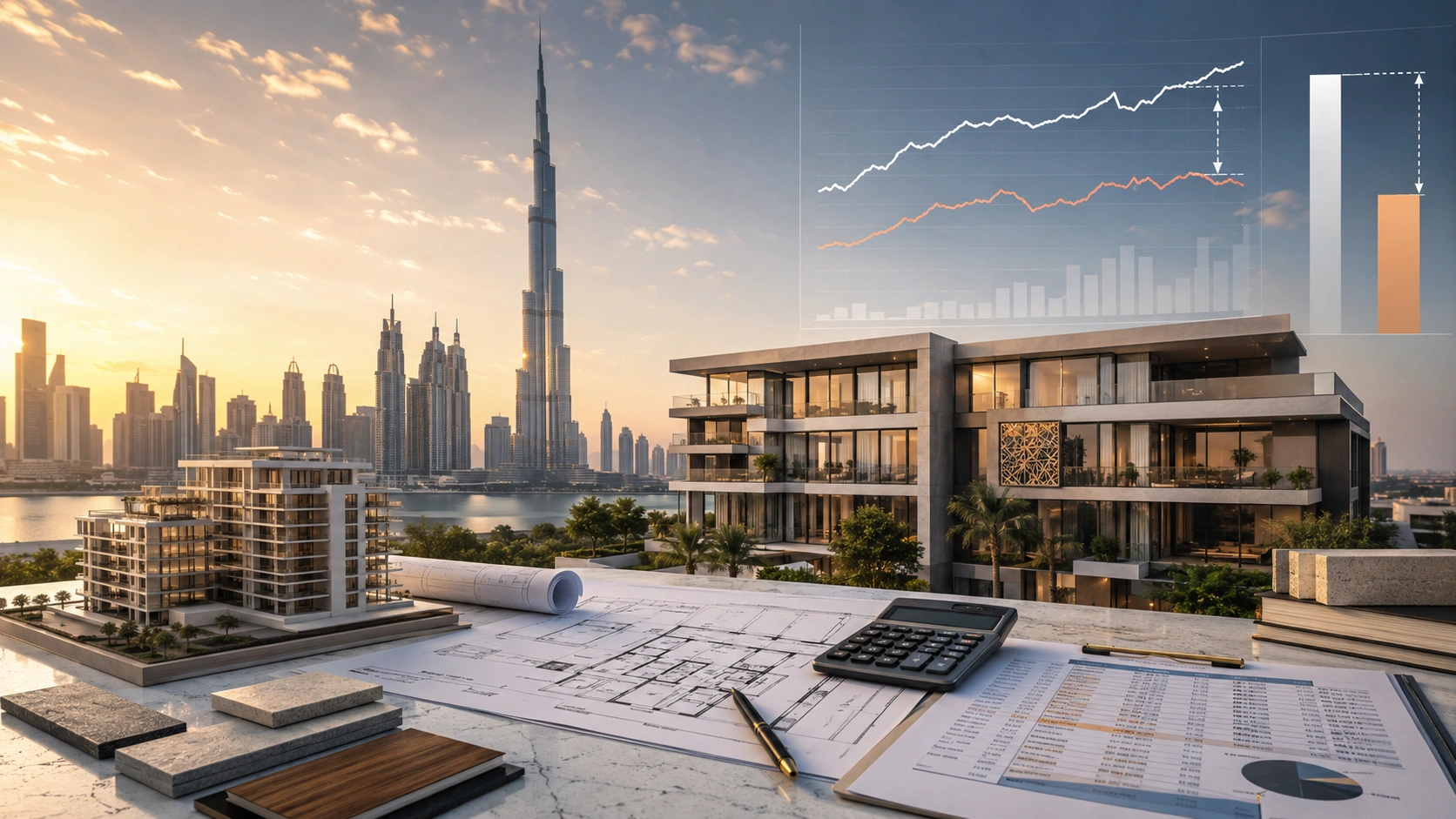
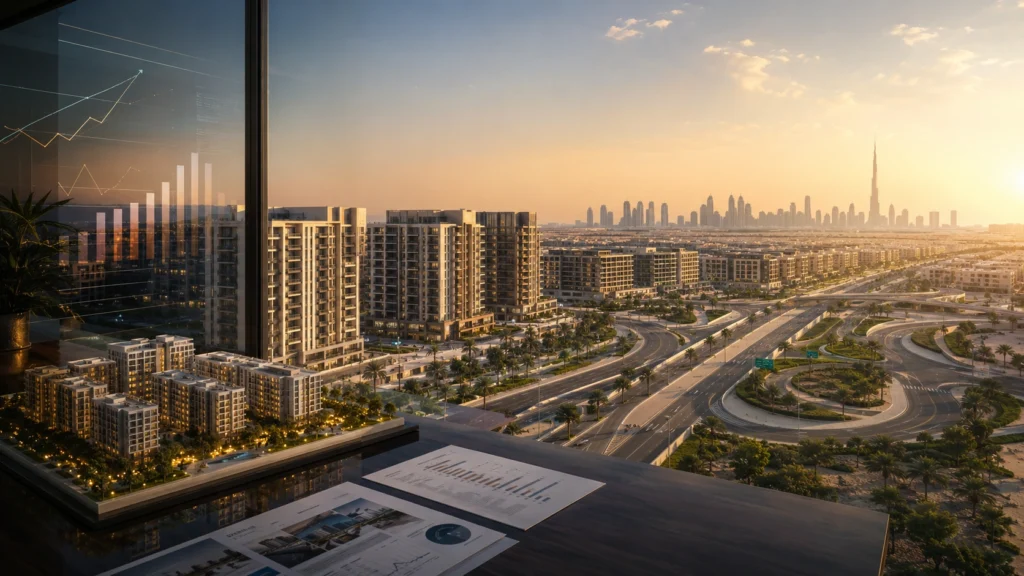
Dubai property prices have risen substantially over the current market cycle, but a higher price does not automatically mean a property is overpriced. The more useful question for a buyer is whether the price is justified by the property’s location, land value, construction quality, comparable transactions, rental potential, and future resale demand.
Replacement cost provides another way to test that price. By estimating what it would cost to reproduce a similar property today, buyers can identify where they may be paying a reasonable market premium and where the gap between underlying value and asking price deserves closer examination.
What Is Replacement Cost in Dubai Property Valuation?
Replacement cost estimates what it would cost, under current conditions, to recreate a property with broadly similar characteristics.
For Dubai residential property, this is not simply the construction cost of the apartment itself. A realistic assessment also needs to consider the value of the land, construction and infrastructure, specifications, common facilities, professional and development costs, and other components required to deliver the finished property.
This distinction is important because construction costs alone are far below the final selling prices of many Dubai properties.
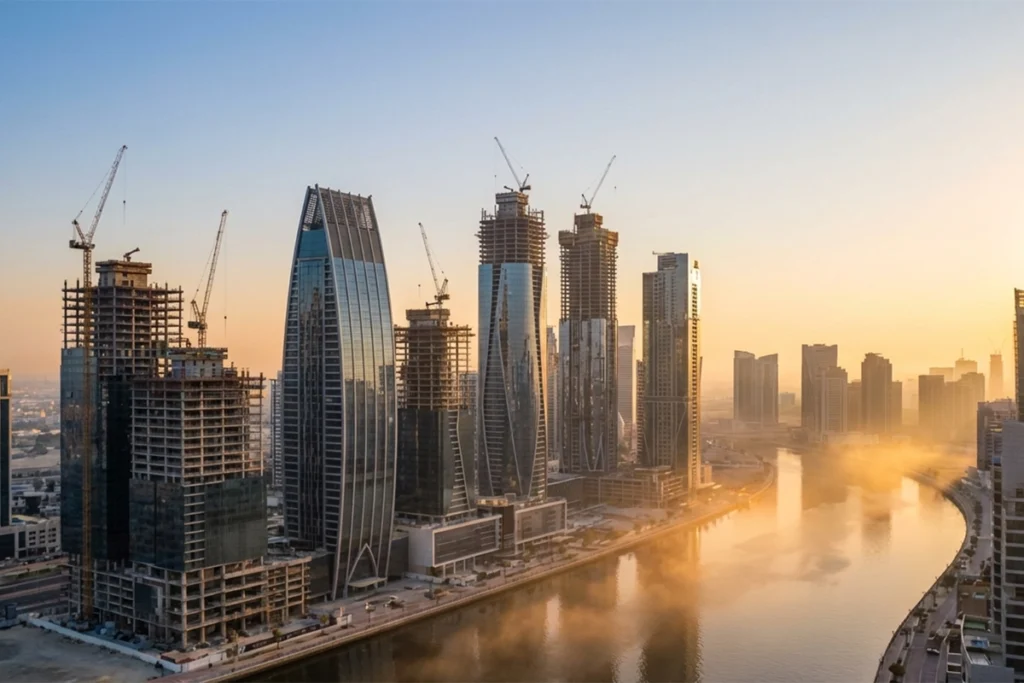
Turner & Townsend’s 2026 construction research estimates average Dubai construction costs across several building types at approximately US$1,990 per square metre. Its more specific tall-building analysis places the shell-and-core construction cost for 20–60-storey residential buildings at roughly AED 470–600 per square foot based on 2025 cost levels. These figures exclude important components such as finishes, external works and utilities, so they should not be treated as the replacement cost of a finished apartment.
The difference between construction cost and sale price is where the valuation becomes more interesting.
A buyer paying AED 2,000 per square foot for an apartment should not conclude that the property is overpriced simply because the structure costs much less to build. Part of that difference may represent valuable land, infrastructure, amenities, development costs, financing, the developer’s margin and, most importantly, the market value of the location.
Replacement cost is therefore best used as a valuation cross-check, not as a substitute for market value.
Start a Conversation
Contact us through the communication method that suits you
Dubai does not have one property price that can be applied across the city.
An apartment overlooking the Burj Khalifa, a waterfront residence on Palm Jumeirah and a new unit in an emerging suburban community can have similar construction specifications while trading at very different prices.
Location is one reason.
Land scarcity, waterfront access, proximity to business districts, established infrastructure, schools, retail, beaches and transport connections can all affect what buyers are willing to pay.
Property type and scarcity matter as well. A limited collection of villas in an established community operates in a different market from a tower containing hundreds of similar studios.
Developer reputation can influence prices, particularly in the off-plan market. Buyers may accept a premium for a developer with a strong delivery history, recognisable design language, established property management and stronger resale recognition.
The final and most important factor is the market itself.
A property’s market value ultimately depends on the price at which willing buyers and sellers are completing comparable transactions. Replacement cost can help assess whether that valuation appears stretched, but it cannot override evidence from genuine market transactions.
What Does the 2026 Dubai Market Tell Buyers?
The market is becoming more selective after several years of strong price growth.
CBRE reported that Dubai residential sales price growth had slowed to around 9% year-on-year in the first quarter of 2026. By Q2, the firm described the residential market as moderating as demand softened, transaction activity declined and additional supply reduced some of the previous pricing pressure.
This matters for buyers because the next phase of the market may place greater emphasis on whether an individual property deserves its asking price.
The enormous volume of new launches also creates more alternatives. Property Monitor recorded more than 167,000 residential units launched during 2025 across 648 projects. It noted that the market was increasingly separating into an off-plan segment influenced heavily by developer launches and pricing strategies, and a completed-property market where buyers were becoming more price-sensitive.
In such a market, a citywide Dubai property price index is useful for understanding direction, but it cannot tell a buyer whether a particular apartment at AED 2,300 per square foot represents good value. That requires property-level analysis.
How Do You Calculate a Property’s Replacement Cost in Dubai?
A professional replacement-cost valuation is more detailed than a simple online calculation. For investment analysis, however, buyers can use the concept to understand what sits underneath the asking price.
The first component is the building itself.
Construction Cost
Construction costs vary substantially according to building height, structural complexity, façade design, MEP systems, materials, specifications and amenities.
Turner & Townsend’s Dubai tall-building research places 2025 shell-and-core costs for residential buildings of 20–60 storeys at approximately AED 470–600 per square foot of gross internal area. For residential towers above 60 floors, the range rises to approximately AED 560–700 per square foot.
These are construction benchmarks, not apartment valuation figures.
They exclude finishes, demolition, external works and utilities, while the finished development also needs to absorb numerous other costs before a property can be delivered and sold.
A luxury tower with complex architecture, expensive façades, high-end interiors and extensive amenities can therefore cost materially more to deliver than a straightforward mid-market residential building.
Land Value
Land can explain a large part of the difference between two otherwise similar properties.
A residential tower on scarce waterfront land cannot be valued in the same way as an equivalent building in a community with a large pipeline of undeveloped plots.
The buyer is effectively purchasing a share of the economic value created by that location, even when the legal structure of apartment ownership is more complex than simply allocating a portion of the plot to each unit.
This is one reason why replacement-cost comparisons should be made within similar locations wherever possible.
Specifications and Building Quality
Flooring, kitchens, sanitaryware, glazing, elevators, façade systems, mechanical systems and common-area finishes can materially change development costs.
The same applies to design efficiency.
Turner & Townsend notes that building shape, height, façade specifications and structural design can have substantial effects on the cost of tall buildings in Dubai.
Buyers should therefore be cautious when comparing two developments purely by their selling price per square foot without understanding what is actually being delivered.
Amenities and Infrastructure
Pools, gyms, landscaped areas, clubhouses, private beaches, sports facilities and large communal areas cost money to construct.
They can also increase the property’s attractiveness to tenants and future buyers.
But amenities create an additional consideration: ongoing service charges.
An expensive amenity package can help justify part of the initial purchase premium while simultaneously reducing the investor’s net rental return if annual operating costs are high.
Development Costs and Developer Margin
The cost of delivering a project extends beyond concrete, steel and finishes.
Professional fees, design, approvals, financing, sales and marketing, infrastructure, project management and the developer’s commercial margin all contribute to the final selling price.
These factors are legitimate components of development economics.
The buyer’s concern is whether the final market premium remains defensible once comparable properties are considered.
Replacement Cost vs Market Value: What Is the Difference?
Replacement cost and market value answer different questions.
Replacement cost asks approximately how much capital would be required to reproduce an equivalent property under current conditions.
Market value asks what buyers are currently willing to pay for that property.
The two values do not need to be equal.
Consider an established waterfront apartment where no equivalent plots are readily available for development. The property may trade significantly above the physical cost of reconstructing the building because buyers are paying for scarcity, location and an established lifestyle.
The same can apply to a prime villa community with limited future supply.
A substantial premium above construction cost can therefore be completely rational.
The valuation becomes more questionable when the premium is difficult to explain.
Imagine a newly launched apartment selling materially above nearby completed properties despite having similar specifications, no significant location advantage and a large amount of competing supply under development.
The construction may be excellent. The project may also be attractive.
But the buyer still needs to determine whether too much future appreciation has already been included in today’s price.
Replacement Cost Is a Warning Signal, Not a Price Target
A common mistake would be to calculate construction and land costs, add a margin and assume that anything above the resulting figure is overpriced.
Property markets do not work that way.
Scarcity can create value. So can an exceptional view, waterfront position, master-community quality, branded operation, superior management, or access to infrastructure that cannot easily be replicated.
Replacement cost is most useful when it makes the buyer ask why a particular premium exists and whether another buyer is likely to pay for that premium in the future.
That final question becomes especially important when buying for investment rather than personal use.
How Can Price per Square Foot Identify Overpriced Dubai Property?
Price per square foot is one of the simplest ways to compare Dubai properties, but it works only when the comparison is relevant.
Citywide averages provide context rather than a valuation.
For example, Property Monitor’s Dynamic Price Index placed average Dubai residential prices at AED 1,673 per square foot in December 2025. Earlier in April, the index had been AED 1,565 per square foot.
Neither figure means that AED 1,700 per square foot is automatically fair for every Dubai property.
The comparison should become progressively narrower.
A buyer should first compare the community, then the sub-community or master development, followed by similar buildings and finally comparable units with similar size, view, floor and condition.
Off-plan properties need an additional comparison with ready stock.
If ready one-bedroom apartments in an area are completing transactions around a certain price per square foot while new launches command a substantial premium, the buyer should investigate what the new project provides in return.
It may have a better payment plan, newer specifications, superior amenities or stronger positioning.
But if the premium depends mainly on the expectation that Dubai property prices will continue rising before handover, the investment carries greater valuation risk.
Use Transactions Before Asking Prices
Listing prices show what owners want.
Transaction prices show what buyers have actually been willing to pay.
This difference matters in a market where sellers can test ambitious prices and developers can position new launches above existing community benchmarks.
Recent comparable transactions should therefore carry more weight than individual property listings when assessing fair market value.
For off-plan purchases, the analysis should also consider what similar completed units cost today and what competing projects are expected to deliver before or around the same handover period.
The objective is not to find the cheapest property. It is to understand whether the price being paid is supported by the market the investor will eventually need to sell into.
What Premiums Are Reasonable for Location, Developer and Amenities?
There is no universal percentage that defines a reasonable property premium in Dubai.
A 20% premium could be excessive in one project and justified in another.
The source of the premium matters more than the percentage itself.
Location Premium
Location is generally one of the strongest reasons for a property to trade above its physical replacement cost.
Waterfront land, established central districts, direct beach access, proximity to major business centres and limited future development capacity can create scarcity that is difficult to reproduce.
A location premium becomes less convincing when similar plots and projects are widely available nearby.
Developer Premium
A recognised developer can command higher prices because buyers may associate the name with delivery reliability, build quality, community management and stronger resale demand.
That premium still has limits.
An investor paying substantially more for the developer’s name should check whether comparable completed projects from the same company actually maintain stronger resale prices or rents.
Brand recognition has investment value when future buyers are also willing to pay for it.
Branded Residence Premium
Branded residences create an even more specialised valuation question.
A genuine hospitality or luxury brand can improve service, positioning and international buyer appeal. In highly scarce locations, this can produce significant premiums.
The investor should still separate lifestyle value from financial return.
A buyer purchasing primarily for personal use may reasonably value concierge services, branding and exclusivity more highly than an investor focused on net ROI.
Amenity Premium
Good amenities can increase tenant demand and make a property easier to market.
But investors should evaluate both sides of the equation.
If better amenities allow the property to achieve AED 15,000 more annual rent but contribute to significantly higher service charges, the net financial advantage may be much smaller than the headline rental difference suggests.
This is why a premium should always be tested against the investor’s actual objective: rental income, capital appreciation, personal use or some combination of the three.
How Does Overpaying Affect Rental Yield, ROI and Resale Value?
The consequences of overpaying often become clearest when the property is evaluated as an investment.
Consider two similar apartments capable of generating AED 100,000 in annual rent.
If Property A costs AED 1.4 million, its gross rental yield is approximately 7.1%.
If Property B costs AED 1.7 million but produces the same rent, the gross yield falls to approximately 5.9%.
The tenant does not care what the investor paid.
Rent is determined by what competing tenants and landlords are doing in the rental market. This means a buyer can pay a substantial premium without receiving a proportionate increase in rental income.
Service charges, maintenance, vacancy and management costs reduce the return further.
Overpaying Can Reduce Future Capital Appreciation
Buying an excellent property does not guarantee an excellent investment return if the entry price is too high.
Suppose an investor buys a unit for AED 2 million while comparable market value is closer to AED 1.8 million.
If the local market subsequently appreciates by 10%, the comparable benchmark may rise to around AED 1.98 million.
The market has performed well, but the investor may still be around the original purchase price before selling costs.
This illustrates why entry price matters even for investors focused primarily on capital appreciation.
The Resale Buyer Will Revalue the Property
Developer marketing influences the initial sale.
The resale market is different.
A future buyer can compare the property with completed units, competing projects, current rents, mortgage valuations and actual transaction evidence.
The premium paid at launch therefore needs to survive contact with a more transparent secondary market.
This is particularly important in areas with large future supply pipelines. If several projects complete around the same time, resale buyers may have substantially more choice than the original off-plan buyer had at launch.
A property purchased at a defensible price has more room to absorb those changes.
What Should Buyers Check Before Paying the Asking Price in Dubai?
The strongest property valuation does not rely on one metric.
Replacement cost can expose a large gap between the underlying development economics and the selling price, but comparable transactions tell the buyer whether the market currently accepts that gap. Rental analysis then shows whether the investment can generate sufficient income at the proposed entry price.
The buyer should therefore establish what similar completed properties have recently sold for, rather than relying primarily on advertised listings.
For an off-plan property, compare the launch price with both ready stock and competing projects scheduled for similar handover dates.
The property’s price per square foot should also be adjusted mentally for differences in view, floor, layout, usable internal area and specifications. A lower price per square foot is not automatically better if much of the area is inefficient or the property has weaker rental appeal.
Service charges deserve particular attention because they directly affect net ROI.
The developer’s track record, project registration, construction progress and future supply around the property should form part of the same assessment.
Finally, consider the exit buyer.
If the property is purchased at a substantial premium today, ask what will persuade another buyer to pay an even higher price several years from now.
A scarce waterfront position, exceptional view, established community, superior building quality or strong rental performance may provide that justification.
A payment plan or launch promotion is less durable because it may no longer matter once the property reaches the resale market.
Is a Dubai Property Overpriced Just Because It Costs More to Replace?
No. Replacement cost is most valuable because it gives buyers another reference point for understanding why a property costs what it does.
Dubai’s property market legitimately assigns premiums to scarce land, waterfront positions, established communities, strong developers, high-quality buildings and assets with exceptional demand. A property can therefore trade substantially above its physical construction cost while still representing fair market value.
The risk appears when the asking price moves far ahead of the factors capable of supporting it.
That question is becoming more relevant as Dubai’s residential market enters a more selective phase. CBRE reported moderation in the residential market during Q2 2026, while the extraordinary volume of projects launched during the previous year means buyers now have more new supply to compare.
For investors, the objective should not be to find property selling closest to its construction cost.
It should be to identify where the premium above underlying cost is supported by location, scarcity, rental income, quality and resale demand — and where the buyer may simply be paying too much at the point of entry.
That distinction can have a larger effect on long-term returns than small differences in payment plans, incentives or advertised ROI.
Frequently Asked Questions
What is replacement cost in Dubai property valuation?
Replacement cost estimates what it would cost, under current conditions, to reproduce a broadly equivalent property. For Dubai real estate, the analysis must consider construction, land, specifications, amenities, and other development costs. It should be used alongside comparable transactions, not as a standalone market valuation.
How do I know if a Dubai property is overpriced?
Compare the property’s price per square foot with recent transactions for genuinely comparable properties, then assess achievable rent, service charges, project quality, location and future supply. A large premium is not necessarily a problem if there is a clear and durable reason why future buyers and tenants should continue valuing the property more highly.
What is a fair price per square foot in Dubai?
There is no single fair price per square foot for Dubai because values differ substantially by community, building, property type, view, condition and development stage. Citywide averages are useful for tracking the market, but property valuation should rely primarily on recent comparable transactions within the relevant submarket.
Why are off-plan properties sometimes more expensive than ready properties?
New projects can command premiums for newer specifications, payment plans, amenities, developer reputation and expected future community development. The premium becomes a concern when the expected rent and future resale value do not reasonably support the additional purchase price.
Does paying more for a well-known developer guarantee better resale value?
No. Developer reputation can support buyer confidence and resale demand, but the entry price still matters. Investors should examine how the developer’s completed projects perform against comparable buildings rather than assuming that every branded or well-known project will maintain an unlimited premium.
Is replacement cost enough to value a Dubai property?
No. Replacement cost is one valuation reference rather than a complete method for determining market value. Comparable transactions, rental performance, location, scarcity, building quality, future supply and resale demand are also necessary to determine whether the asking price is reasonable.