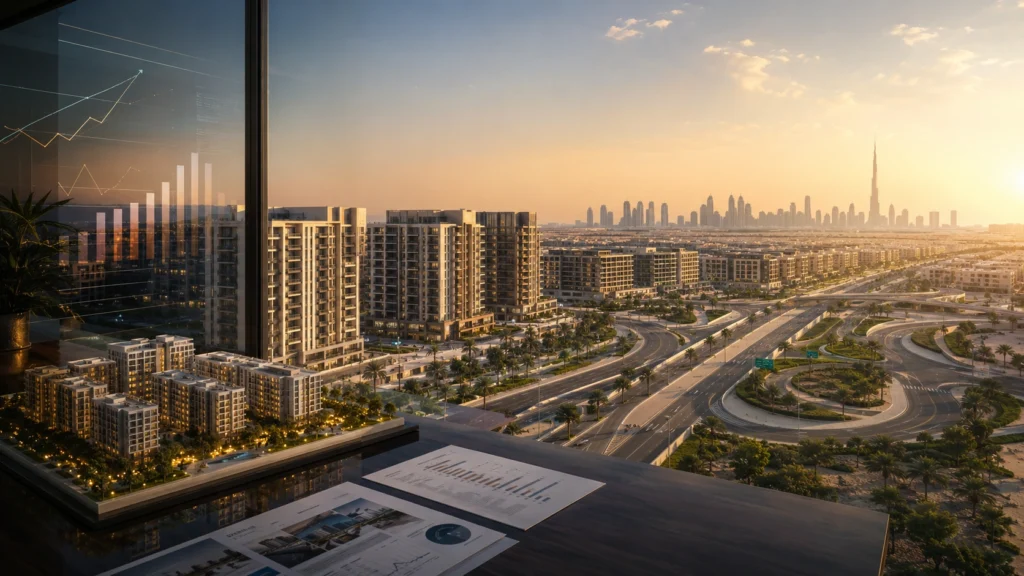
The Dubai property market entered August 2026 with lower transaction volume but broadly stable residential pricing. DLD-registered data shows the median residential price remained close to AED 1,690 per square foot, while off-plan property continued to account for roughly two-thirds of sales.
For investors, the more important change was beneath the headline numbers. Transaction volumes cooled from July, yet ready properties remained resilient, rental demand continued to support income-focused communities, and yields varied widely across Dubai. August therefore strengthened the case for selecting property by entry price, realistic rent and competing supply, rather than assuming every area will follow the same market direction.
August marked a shift from the stronger transaction volumes recorded earlier in the summer.
Analysis of Dubai Land Department registrations places total registered sales at roughly 12,000 transactions during August, compared with more than 14,000 in July. Differences of several hundred transactions can appear between datasets because some analyses isolate residential properties while others include a broader range of registered property types.
The direction, however, is consistent: sales activity declined month on month.
DLD-derived residential data shows the median price per square foot remained almost unchanged. One complete-month dataset placed August at approximately AED 1,692 per square foot, compared with AED 1,694 in July.
That is a movement of only around 0.1%.
This distinction matters.
Lower transaction volume does not automatically mean falling property values. August showed fewer transactions while the median price per square foot remained relatively stable.
The composition of demand also continued to favour off-plan property.
Approximately 68% of registered sales were off-plan according to broader DLD-derived transaction data, keeping new developments at the centre of Dubai’s sales market.
However, ready property showed a different form of strength.
A mix-adjusted index calculated from DLD registrations showed ready-property prices rising approximately 0.8% month on month, compared with around 0.2% for off-plan property.
For buyers, August was therefore less about a citywide correction and more about increasing differences between segments.
Start a Conversation
Contact us through the communication method that suits you
How Many Dubai Property Sales and Transactions Were Recorded in August?
Dubai recorded approximately 12,000 registered property sales in August 2026, depending on the property categories included in the calculation.
One DLD-derived complete-month dataset recorded 11,972 sales, compared with 14,143 in July.
A residential-only analysis identified 11,147 home sales worth AED 21.43 billion during August.
The residential figure was approximately 11.5% lower than July, while the value of registered residential sales remained comparatively resilient.
The reason was the changing transaction mix.
Lower-priced transactions declined more noticeably, while activity in higher-value properties strengthened.
DLD-derived analysis recorded 193 residential transactions worth AED 10 million or more during August, compared with 149 in July.
Those AED 10 million-plus transactions represented approximately AED 4.04 billion in registered value.
This indicates that the decline in overall transaction numbers did not affect every segment equally.
August also contained fewer working days than a typical month, which should be considered when comparing the total directly with July.
More importantly, investors should avoid using transaction volume alone as a measure of market health.
Fewer sales can result from seasonality, launch schedules, available inventory and registration timing. The more useful question is whether prices, liquidity and rental demand weakened simultaneously.
In August, the evidence was more mixed.
Volumes declined, but residential prices remained broadly stable and high-value transactions continued to attract capital.
What Happened to Dubai Property Prices in August 2026?
The clearest signal from August was price stability rather than another broad acceleration.
DLD-derived data placed the median residential transaction price at approximately AED 1,692 per square foot, virtually unchanged from July’s AED 1,694.
The median residential transaction value was approximately AED 1.2 million.
However, investors should distinguish between the raw median and a property price index.
A median can move because different types of properties sell during a particular month. For example, more luxury transactions can increase the median even when individual communities are stable.
A mix-adjusted residential index calculated from registered DLD sales showed a 0.1% month-on-month decline in August.
The same index showed different behaviour across property categories.
Apartments declined approximately 0.1% month on month, while villas decreased around 0.2%.
The ready segment performed better, increasing approximately 0.8%, while the off-plan segment recorded around 0.2% growth.
This is important for investors comparing ready and off-plan opportunities.
The off-plan market still dominates transaction volume, but that does not automatically mean it is producing stronger immediate price growth.
Ready properties offer a different advantage: buyers can evaluate the finished product, existing community, service charges and achievable rent before purchasing.
August therefore reinforced a trend already becoming more important in 2026.
Dubai property prices are increasingly dependent on the individual community, project and entry price rather than a single citywide growth rate.
Which Dubai Areas Recorded the Strongest Price Growth?
The August market was highly fragmented at community level.
Some locations continued to record substantial year-on-year increases, while others showed flatter or weaker price movement.
DLD-derived community data placed DAMAC Hills among notable performers, with its median price per square foot around AED 1,670 and year-on-year growth of approximately 27.7% in one registry-based comparison.
Mudon also showed strong annual performance, with median pricing around AED 1,699 per square foot and annual growth above 20% in the same dataset.
Other communities recording significant increases included parts of Jebel Ali and selected emerging or newly transacting districts.
However, these percentages require careful interpretation.
A sharp annual increase does not always mean every existing property in that community appreciated by the same amount.
The mix of projects being sold can change considerably.
A community where newer premium projects represent a larger share of current transactions can show a rising median price per square foot even when older buildings experience more moderate appreciation.
This is particularly important in areas with substantial off-plan activity.
For investors, the practical approach is to compare the property with transactions involving the same building, project, unit type and development stage whenever enough evidence exists.
Citywide and community averages help identify direction. They should not determine what an individual property is worth.
Dubai’s rental market remained an important support for property investment during 2026.
Official DLD data for the first quarter had already recorded AED 32.2 billion in rental-contract value, including 118,385 new contracts and 135,607 renewals. This demonstrated substantial depth in the tenant market entering the remainder of the year.
DLD also operates its Rental Index using property characteristics, location and current annual rent to provide market rental information.
By August, the key investor story was not simply whether Dubai rents were rising.
It was the relationship between rent and purchase price.
When property prices rise faster than rents, rental yields compress. When rents remain strong while acquisition prices stabilise, yields can become more attractive.
August produced substantial differences between communities.
Income-oriented apartment areas continued to offer gross yields well above those available in Dubai’s most expensive prime locations.
For example, DLD-sale and Ejari-rent comparisons placed Dubai Sports City around 7.7% gross, while International City was above 9% in one registry-based methodology.
These are gross yields before service charges and other expenses.
An apartment purchased for AED 700,000 and rented for AED 52,000 annually generates approximately 7.4% gross.
If annual service charges, maintenance and vacancy reduce the investor’s effective income to AED 42,000, the simplified net yield falls to 6%.
This is why investors should not compare Dubai communities using advertised rental yield alone.
Which Areas Delivered the Best Property ROI in August?
The highest-yield areas in August were generally not Dubai’s most expensive communities.
Instead, strong income performance remained concentrated in areas where acquisition prices were relatively accessible compared with annual rents.
Registry-based comparisons using DLD sales and Ejari rents placed International City around 9% gross and Dubai Sports City around 7.7%.
Dubai Silicon Oasis was also around the mid-to-high 7% range in the same methodology.
Other market datasets placed communities such as Dubai South, Al Furjan and Arjan among areas capable of generating attractive apartment yields, although the exact percentage varies by building and methodology.
Prime locations generally produce lower percentage yields because investors pay more for land scarcity, lifestyle, views and long-term capital-value expectations.
That does not necessarily make them weaker investments.
Consider two properties.
A lower-priced apartment may generate 7.5% gross rental yield but experience limited capital appreciation.
A premium property might produce 5% gross yield while benefiting from stronger long-term appreciation and deeper high-end resale demand.
The better investment depends on the buyer’s objective.
Investors prioritising income should examine communities where the relationship between purchase price and registered rent remains favourable.
Those prioritising wealth preservation or capital appreciation may accept lower rental yield for a scarcer property.
For both strategies, Dubai property ROI should be calculated from the actual acquisition price, not an area-wide advertised percentage.
Off-Plan vs Ready Property: Where Was Buyer Demand Strongest?
Off-plan property remained the dominant segment of the Dubai sales market in August.
DLD-derived complete-month data places the off-plan share at approximately 68% of registered sales.
Another residential methodology places the proportion higher because of differences in classification and the transactions included.
Regardless of the precise methodology, the conclusion is clear: off-plan remained the largest source of sales activity.
This reflects Dubai’s substantial development pipeline, payment-plan structures and continued demand for newly launched projects.
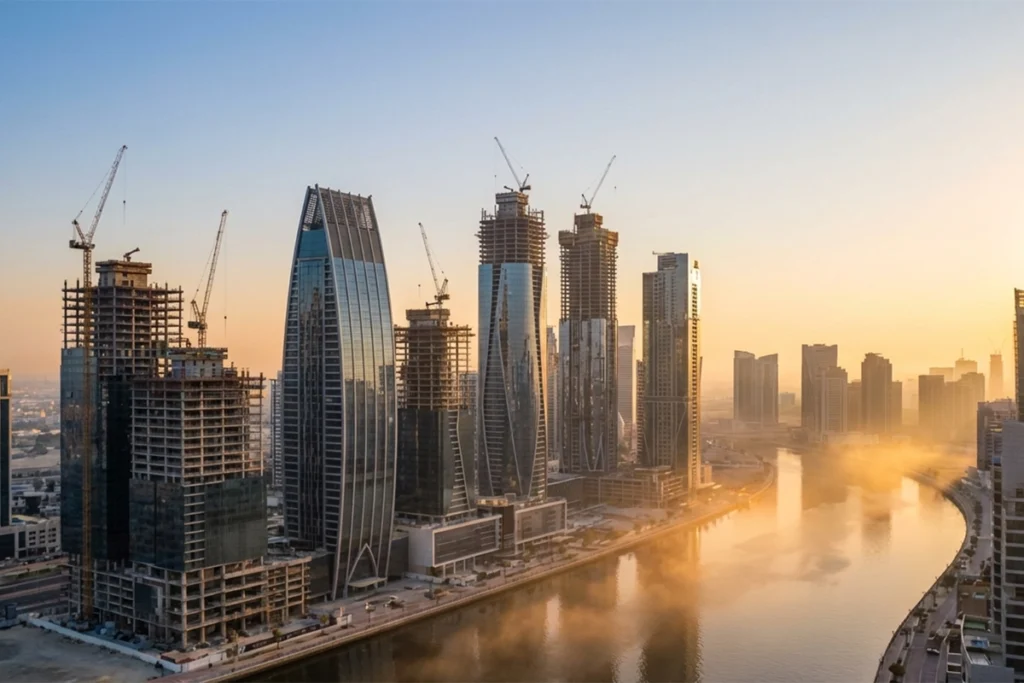
The scale of future supply also continued expanding.
Official DLD figures released in August showed that 104 real estate projects were completed during the first half of 2026, up from 75 during the same period of 2025.
The investment value of completed projects exceeded AED 111 billion.
More importantly for residential investors, 24,537 new property units were completed during H1 2026, an increase of more than 36% from 18,043 units during H1 2025.
That supply is not automatically negative.
Dubai’s population, business base and international investor market continue to create housing demand.
However, investors should examine how much competing inventory is arriving in the specific community and unit category they are buying.
A citywide increase in supply has little relevance if a property belongs to a genuinely scarce segment.
Conversely, a one-bedroom off-plan apartment can face significant competition if several neighbouring projects deliver hundreds of similar units simultaneously.
Ready property provides a different proposition.
Investors can inspect the property, measure actual rental demand and potentially begin generating income immediately.
The August price data also showed relative resilience in the ready segment.
Therefore, the decision between ready and off-plan should not be based simply on which segment recorded more transactions.
It should be based on whether the off-plan price premium and future potential compensate for construction time and incoming supply.
What Do August 2026 Market Trends Mean for Buyers and Investors?
August did not show a Dubai property market moving uniformly upward or downward.
It showed a market becoming more selective.
Sales volumes declined from July, but median residential pricing remained close to AED 1,690 per square foot.
Off-plan property continued to dominate sales, while ready-property pricing showed resilience.
Rental demand remained deep enough to support attractive yields in several affordable and mid-market communities.
At the same time, the supply pipeline continued to grow.
Official DLD figures showing more than 24,500 new units completed during the first half of 2026 make future competition an increasingly important part of investment analysis.
For buyers, this changes the decision process.
A rising Dubai market no longer provides enough justification for paying any launch price.
Investors should compare the asking price with recent registered transactions, then calculate the realistic rent and deduct service charges.
Off-plan buyers should also examine the number of competing units expected around handover.
Ready-property investors should evaluate building condition, maintenance costs and whether current rents can be sustained.
For yield-focused buyers, communities with moderate acquisition prices and strong tenant demand remain attractive.
For capital-growth investors, scarcity becomes more important. Waterfront positions, prime land, low-density villa communities and genuinely differentiated properties may justify lower immediate yields.
The August 2026 data therefore supports a more disciplined approach.
Dubai remains an active and liquid property market, but the investment opportunity is increasingly property-specific rather than market-wide.
The strongest purchase is not necessarily in the area with the highest annual growth or the project with the busiest launch.
It is the property where the current entry price, realistic rental income, future supply and resale demand still leave enough room for the investor’s return.
Check more opportunities in Dubai
Binghatti Spectre
LEOS Royal
Sakura Gardens
Check now
Frequently Asked Questions
Did Dubai property prices fall in August 2026?
Prices were broadly stable. DLD-derived data placed the median near AED 1,692 per sq ft, around 0.1% below July.
How many properties were sold in Dubai in August 2026?
Around 12,000 sales were registered, depending on categories included. Residential-only analysis recorded roughly 11,147 home sales.
Was off-plan or ready property more popular in August?
Off-plan remained dominant, accounting for roughly two-thirds of registered sales under broad DLD-derived classifications.
What was the average Dubai property price per square foot?
The August residential median was approximately AED 1,690 per square foot, although prices varied substantially by community and property type.
Which Dubai areas offered strong rental yields in August?
Income-focused areas such as International City and Dubai Sports City produced some of the stronger gross yields in registry-based comparisons.